
AI Invoice Parsing Software for Businesses in India
Processing invoices manually can become increasingly time-consuming as businesses grow and transaction volumes increase. Finance teams often spend hours reviewing invoices, extracting data, validating GST information, and entering records into accounting systems before books can be finalized.
Indian invoices add a layer of complexity that global invoice processing tools often struggle with: mandatory GST fields. Every GST-compliant invoice must carry the supplier's GSTIN, the buyer's GSTIN (for B2B), HSN or SAC code, the applicable GST rate, and separately stated CGST/SGST or IGST amounts. Beyond this, e-invoices (mandatory for businesses above ₹5 crore turnover) carry an IRN (Invoice Reference Number) and a QR code that encodes key transaction data. AI invoice parsing built for Indian businesses needs to handle all of these fields not just extract the total amount.
AI Invoice Parsing Software helps businesses automatically extract invoice data, reduce manual data entry, improve bookkeeping accuracy, and maintain structured financial records. By converting invoice information into organized accounting data, businesses can streamline invoice processing, support GST accounting workflows, improve reconciliation readiness, and accelerate month-end financial operations.
Whether you process 50 invoices a month or 5,000, the challenge is the same: transforming unstructured invoice documents into accurate, GST-compliant accounting records without errors. Flick AI's invoice automation software handles this for Indian businesses across every invoice format, every vendor, and every GST scenario.
What Is AI Invoice Parsing Software?
Invoice processing has traditionally been a manual accounting task. Finance teams receive invoices from vendors, suppliers, service providers, and contractors in various formats, including PDFs, scanned documents, email attachments, and images. Information from these invoices is then manually reviewed and entered into accounting systems, spreadsheets, or bookkeeping software before it can be used for accounting, GST compliance, reconciliation, or reporting.
A typical invoice contains several important data fields, including vendor names, invoice numbers, invoice dates, GSTIN details, taxable values, tax amounts, line items, and total invoice values. Manually extracting and entering this information can be time-consuming, particularly for businesses processing large volumes of invoices every month.
Many businesses are familiar with Optical Character Recognition (OCR), which helps convert scanned documents into machine-readable text. While OCR can identify text from invoices, it does not always understand the meaning or structure of the information being extracted. AI Invoice Parsing Software goes a step further by identifying relevant invoice fields, understanding document structure, and converting invoice information into organized accounting data.
Modern AI invoice parsing systems are designed to extract key invoice fields and line-item information from PDFs, scanned invoices, images, and digital documents. Rather than requiring manual entry, invoice data can be captured automatically and organized into structured records that support AI Bookkeeping Software, GST Accounting Software, bank reconciliation, financial reporting, and broader accounting workflows.
By transforming invoice information into accounting-ready data, AI Invoice Parsing Software helps businesses reduce manual processing effort, improve data accuracy, and maintain more organized financial records as invoice volumes grow.
Why Manual Invoice Processing Becomes Difficult as Businesses Grow
Manual invoice processing often works effectively when businesses receive a relatively small number of invoices each month. However, as organizations grow, invoice volumes increase, vendor relationships expand, and compliance requirements become more complex. What initially appears to be a simple administrative task can gradually become a significant operational bottleneck that impacts bookkeeping, GST accounting, reconciliation, and financial reporting workflows.
Increasing Invoice Volumes
The volume problem with invoices is different from general transaction volume. Invoices require structured review: every field must be read, validated against the purchase order or contract, and entered correctly into the accounting system. A business going from 100 to 800 vendor invoices per month hasn't just increased its workload by 8x the validation and entry requirements have increased at the same rate. There is no shortcut to manual invoice entry at high volumes except automation.
GST Validation Requirements
This is where Indian invoice processing diverges significantly from global contexts. Each vendor invoice needs to be validated not just for the amount, but for: (1) Is the supplier's GSTIN valid and active? (2) Does the GSTIN match the supplier's registered name? (3) Is the HSN/SAC code correct for the goods or services described? (4) Is the GST rate applied correct for that HSN/SAC code? (5) Has the invoice been reported by the supplier in their GSTR-1? Each of these validations, done manually, adds 3–5 minutes per invoice. For 500 invoices a month, that's 25–40 hours of validation work. Businesses often combine invoice automation with GST Accounting Software workflows to improve compliance readiness and reporting accuracy.
E-invoice and IRN Verification
E-invoices carry an IRN and a digitally signed QR code. For buyers receiving e-invoices, AI parsing can read the QR code to extract and verify all mandatory fields in seconds and flag invoices where the QR code data doesn't match the printed values (a sign of document tampering or error).
Multi-Format Vendor Invoices
Indian vendor invoices come in virtually every format: system-generated PDFs from accounting software, scanned images of printed invoices, WhatsApp photos of handwritten bills, Excel sheets, and structured e-invoices. Each format requires different extraction logic. AI invoice parsing built for Indian businesses handles all of these input formats without requiring vendors to change how they send invoices.
How AI Invoice Parsing Software Works
As invoice volumes increase, manually extracting data from invoices can become one of the most time-consuming accounting activities. AI Invoice Parsing Software helps businesses convert invoice information into structured accounting data that can support bookkeeping, GST accounting, reconciliation, and reporting workflows. Flick AI is designed to simplify this process by reducing manual effort while improving the accuracy and organization of invoice records.
Step 1: Receive invoices from any source
Invoices arrive through multiple channels: email attachments, WhatsApp forwards, supplier portals, ERP exports, and direct uploads. Flick AI accepts invoices from all of these inputs without requiring vendors to change their delivery method. Invoices are queued for processing as they arrive not batched for weekly entry.
Step 2: Document type identification
Before extraction begins, the system identifies what type of document it's processing: a purchase invoice, a credit note, a debit note, a proforma, or a non-GST bill. Different document types require different field extraction logic. Misidentifying a credit note as an invoice would create an accounting error downstream.
Step 3: Field-level data extraction
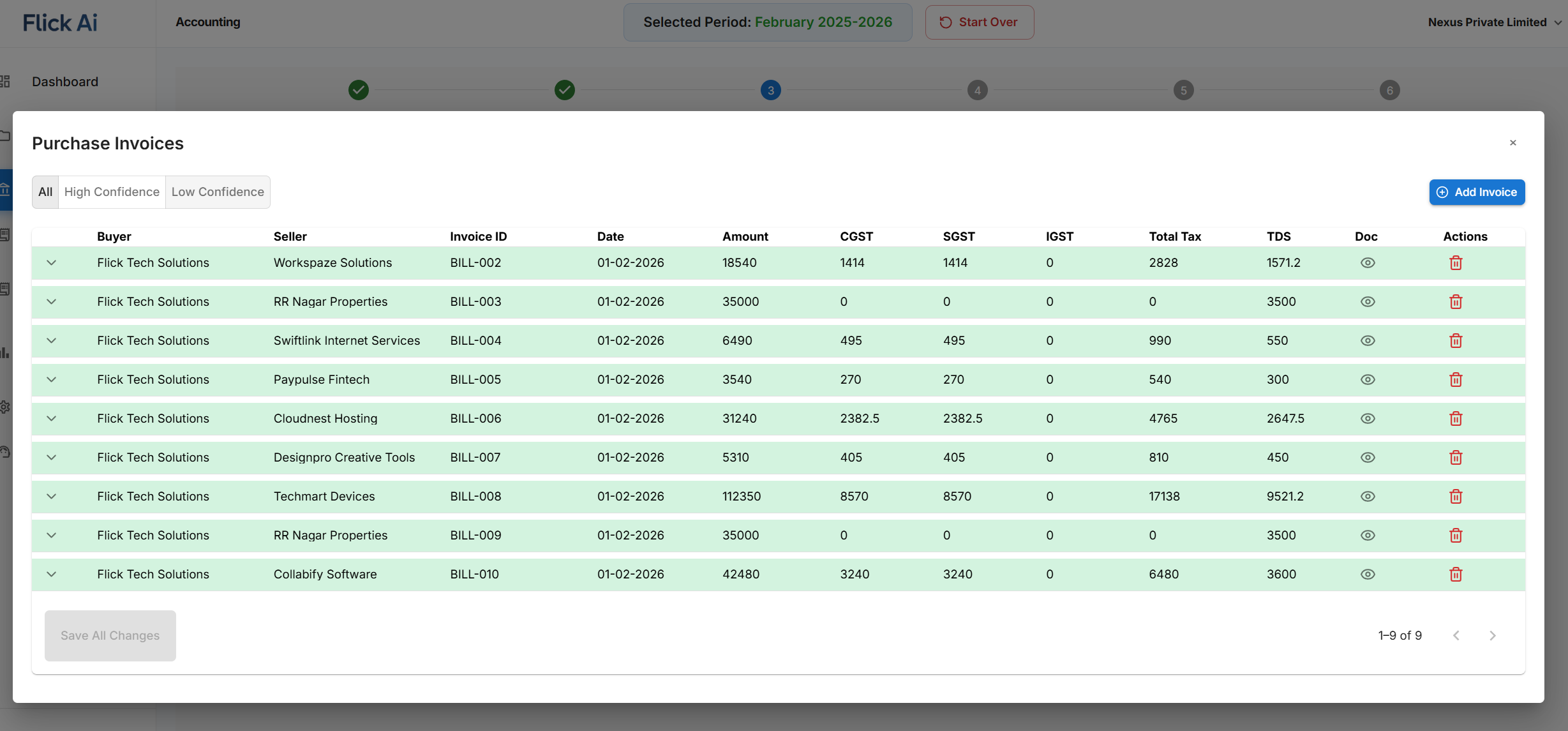
For each invoice, the system extracts: supplier name, supplier GSTIN, buyer GSTIN, invoice number, invoice date, place of supply, HSN/SAC codes, description of goods/services, quantity, rate, taxable value, CGST/SGST/IGST amounts, total invoice value, and payment terms. For e-invoices, the IRN and QR code data are also captured and cross-validated against printed fields.
Step 4: GST compliance validation
Extracted GST data is validated automatically: Is the supplier GSTIN valid? Does the invoice number follow the supplier's declared sequence? Does the CGST + SGST total equal the IGST equivalent for interstate supplies? Are the HSN codes at the correct digit level (4-digit, 6-digit, or 8-digit depending on turnover)? Invoices that fail validation are flagged before they enter the accounting system not discovered at filing time.
Step 5: Duplicate detection
Before an invoice is accepted into the system, it's checked against existing records: same supplier, same invoice number, same amount. Duplicate invoices whether from a re-sent email or a second delivery from a supplier portal are flagged for confirmation rather than auto-entered.
Step 6: Accounting-ready output
Validated invoice data is output as structured accounting records: ledger entries, GST classifications, and payables entries. These records are ready for bookkeeping, reconciliation, and GST reporting without any additional data entry. Businesses seeking stronger transaction matching capabilities can also benefit from Automated Bank Reconciliation Software workflows that build upon accurate invoice and accounting data.
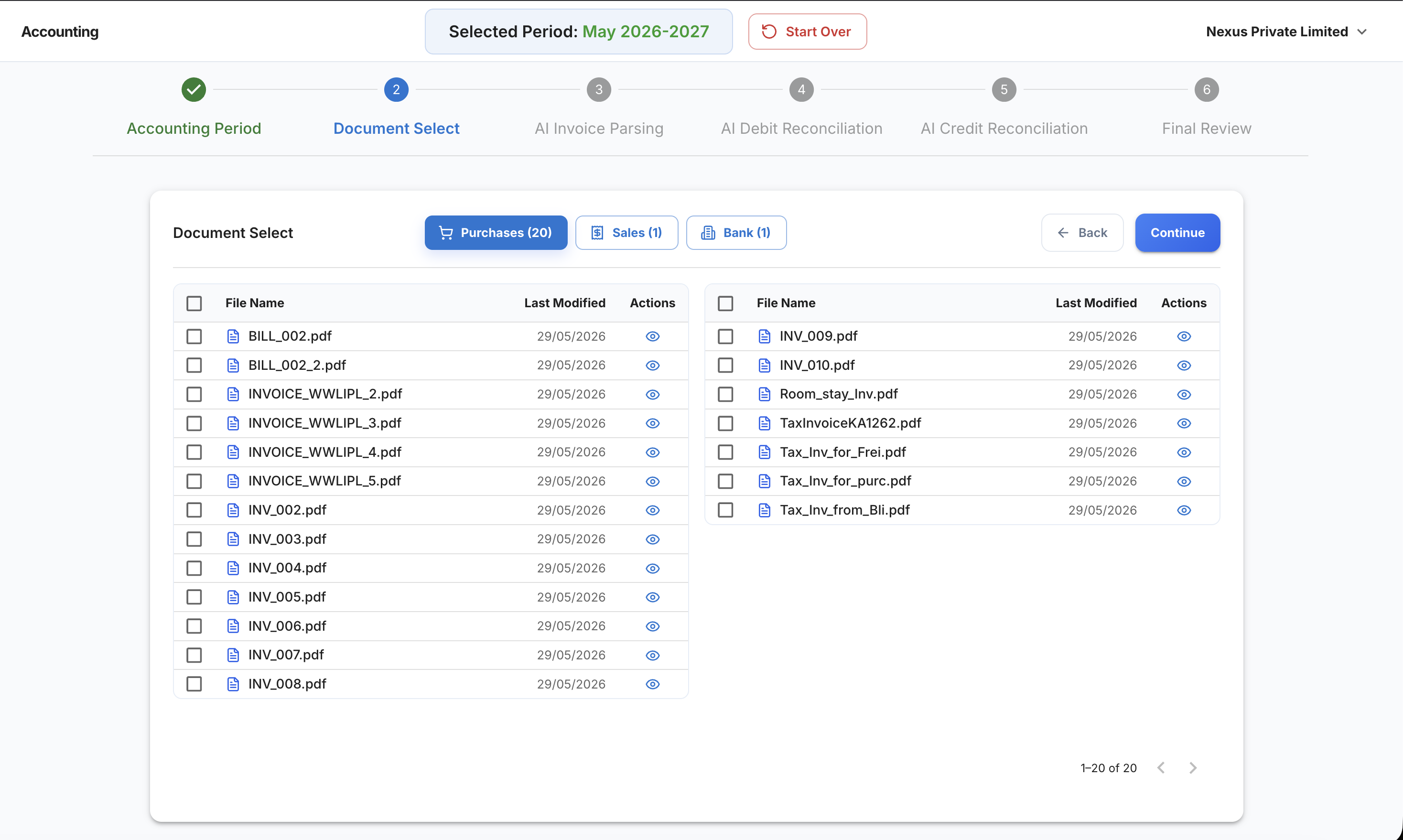
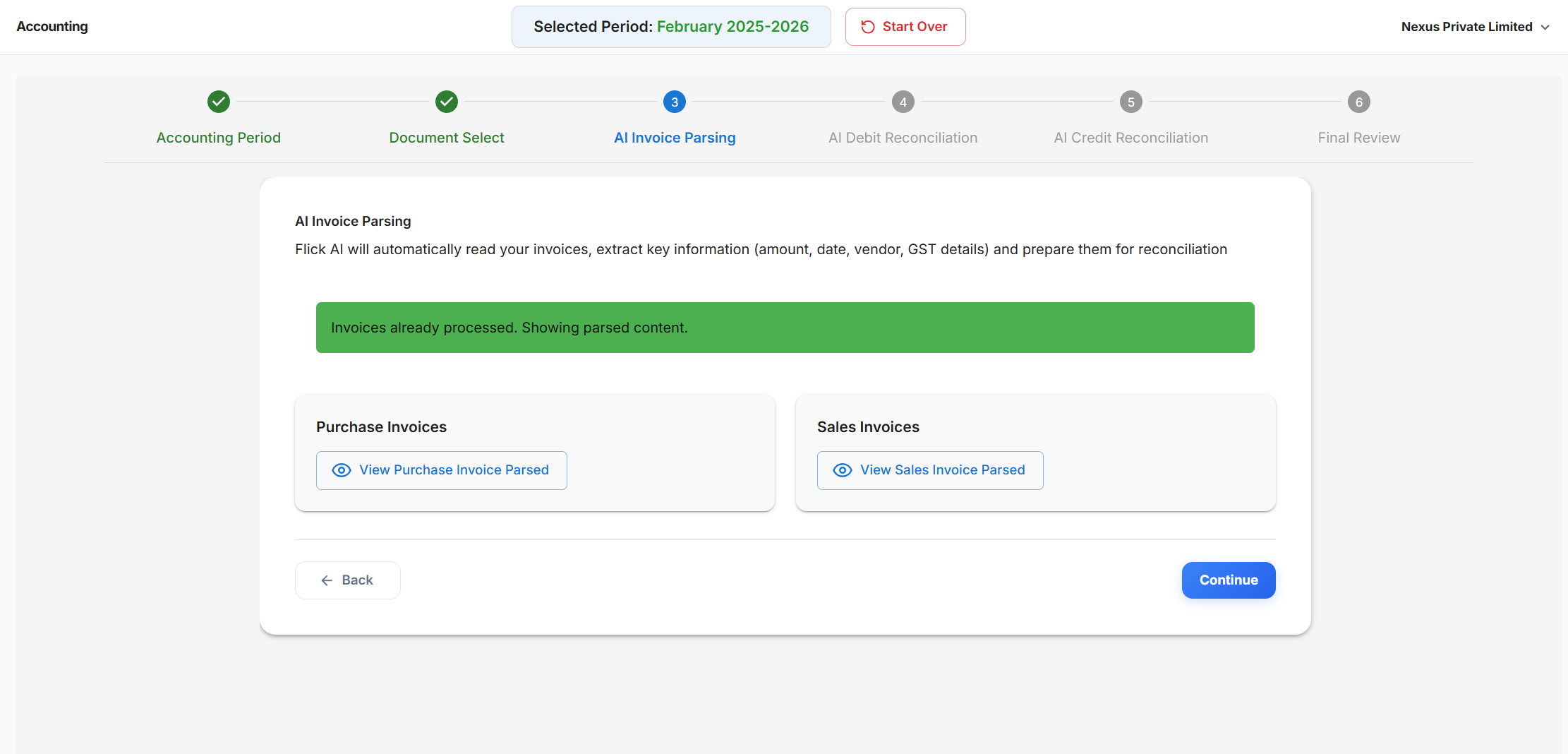
Product proof
Screens from the Flick AI workflow
Key Benefits of AI Invoice Parsing Software
Reduced Manual Data Entry
Manual invoice entry is one of the most repetitive tasks within accounting and finance workflows. Finance teams often spend significant time reviewing invoices, locating key information, and entering data into accounting systems. AI Invoice Parsing Software helps reduce this effort by automatically extracting invoice information and converting it into structured accounting data. By minimizing manual data entry requirements, businesses can improve operational efficiency and allow finance teams to focus on higher-value activities such as analysis, reconciliation, and reporting.
Faster Invoice Processing
As invoice volumes increase, manual processing can quickly become a bottleneck. AI Invoice Parsing Software helps accelerate invoice workflows by extracting and organizing invoice data automatically. Faster invoice processing enables businesses to reduce delays in bookkeeping, GST accounting, vendor management, and financial reporting. This becomes particularly valuable during month-end periods when finance teams are working under tighter reporting deadlines.
Improved Accuracy
Manual data entry increases the likelihood of errors in invoice numbers, vendor details, GST information, tax amounts, and accounting records. AI Invoice Parsing Software helps improve consistency by systematically extracting invoice information and reducing dependence on repetitive manual processes. More accurate invoice records contribute to stronger bookkeeping, improved reconciliation outcomes, and more reliable financial reporting.
Better GST Readiness
Invoice data plays a critical role in GST accounting and compliance workflows. Accurate invoice information helps support GST classification, Input Tax Credit validation, reconciliation activities, and reporting preparation. AI Invoice Parsing Software helps businesses maintain more organized invoice records and improve the quality of GST-related financial information before compliance activities begin.
Faster Month-End Closing
Month-end closing often requires finance teams to process large volumes of invoices, validate records, complete reconciliations, and prepare reports within limited timeframes. AI Invoice Parsing Software helps reduce the time spent extracting and organizing invoice data, enabling accounting teams to move more quickly into review, reconciliation, and reporting activities. Faster invoice processing often contributes directly to improved month-end efficiency.
Scalable Accounting Operations
Processes that work effectively for 100 invoices per month may become difficult to manage at 1,000 or 2,000 invoices per month. AI Invoice Parsing Software helps businesses scale accounting operations by reducing the amount of manual effort required to process increasing invoice volumes. This enables finance teams to support business growth without proportionally increasing administrative workload.
Invoice Parsing and ITC Optimization: The Financial Impact
Most businesses focus on invoice parsing as a time-saving tool. The less-discussed benefit is financial: accurate invoice parsing directly increases the Input Tax Credit a business can legitimately claim.
What Incomplete Invoice Capture Costs
When invoices are manually entered and fields like GSTIN or HSN code are skipped (because the person entering is moving quickly through a large batch), those invoices have incomplete GST records. Under GST rules, ITC can only be claimed on invoices with complete and accurate GST information. For a business with ₹50 lakh in annual vendor purchases at 18% GST, that's ₹9 lakh of potential ITC. If 15–20% of invoices have incomplete GST data due to manual entry, ₹1.35–1.8 lakh of ITC is at risk annually.
GSTR-2B Matching at Scale
GSTR-2B shows inward supplies reported by your vendors. For ITC to be fully utilizable, your purchase records need to match what's in GSTR-2B. When invoice parsing captures invoice numbers and supplier GSTINs accurately, GSTR-2B matching can be automated — identifying discrepancies (supplier hasn't filed, invoice number mismatch, amount difference) in minutes rather than hours.
AI Invoice Parsing vs Manual Invoice Entry
Many businesses begin invoice processing manually by reviewing invoices, extracting information, and entering data into accounting systems or spreadsheets. While this approach can work effectively for low invoice volumes, it often becomes increasingly difficult to maintain as businesses grow. AI Invoice Parsing Software helps automate invoice data extraction and organization, reducing manual effort while improving consistency and scalability.
Manual invoice entry is not necessarily a problem for every business. Organizations processing a relatively small number of invoices each month may continue to manage invoice workflows effectively using existing processes. However, as invoice volumes increase, businesses often find that manual extraction, GST validation, vendor management, and data entry consume a growing amount of finance team capacity. AI Invoice Parsing Software helps address these challenges by converting invoice information into structured accounting data that supports bookkeeping, GST accounting, reconciliation, and reporting workflows.
Invoice Processing for Different Business Types
Invoice processing requirements vary significantly depending on the nature of a business, transaction volumes, vendor relationships, and operational complexity. While every organization processes invoices, the challenges associated with managing invoice data often differ across industries and business models.
Startups
Startups often begin with relatively simple invoice workflows, managing vendor bills, software subscriptions, professional services, and operational expenses manually. As teams grow, invoice volumes increase through recurring SaaS subscriptions, employee reimbursements, marketing expenses, and vendor payments. Many startups initially rely on spreadsheets or manual bookkeeping processes, but invoice management can quickly become time-consuming as transaction volumes increase. Maintaining organized invoice records becomes particularly important for investor reporting, GST compliance, and financial visibility. Many growing startups eventually adopt Accounting Software for Startups to improve financial visibility and reporting readiness.
E-commerce Businesses
E-commerce businesses typically process high volumes of supplier invoices, logistics expenses, marketplace charges, advertising costs, inventory purchases, and payment gateway fees. Invoice processing often involves multiple vendors, frequent transactions, and varying document formats. Managing invoice records accurately becomes critical for expense tracking, GST accounting, vendor reconciliation, and maintaining profitability visibility across products and sales channels.
SaaS Companies
SaaS businesses frequently manage recurring software subscriptions, cloud infrastructure invoices, marketing platform expenses, contractor invoices, and international vendor payments. As businesses scale, tracking recurring costs and maintaining accurate invoice records becomes increasingly important for understanding operating expenses, gross margins, and financial performance. Invoice data also plays an important role in investor reporting and financial planning activities.
Service Businesses
Service businesses often work with consultants, freelancers, contractors, agencies, and specialized vendors. Invoice processing challenges frequently arise from project-based billing, recurring retainers, milestone payments, and varying payment schedules. Maintaining accurate invoice records supports better expense tracking, client profitability analysis, GST compliance, and overall financial management.
Accounting Firms
Accounting firms frequently process invoices across multiple clients while managing different accounting systems, reporting requirements, GST categories, and documentation standards. As client portfolios grow, manual invoice handling can become difficult to scale efficiently. Automated invoice extraction helps accounting teams improve consistency, reduce repetitive data entry, and maintain organized financial records across multiple engagements.
Signs Your Business Needs Invoice Automation
Manual invoice processing can work effectively for businesses with relatively low invoice volumes and simple accounting workflows. However, as organizations grow, invoice management often becomes increasingly time-consuming and difficult to scale. If several of the situations below sound familiar, it may be a sign that your business has outgrown manual invoice processing methods.
Your business processes more than 500 invoices each month.
Finance teams spend significant time manually reviewing and entering invoice data.
GST validation and invoice verification require substantial manual effort.
Vendor invoices arrive in multiple formats, layouts, and document structures.
Month-end closing is frequently delayed because invoice processing is incomplete.
Multiple team members are involved in reviewing, validating, or entering invoice information.
Invoice-related data entry errors require corrections and rework.
Approval workflows are difficult to monitor and manage consistently.
Invoice information is maintained across spreadsheets, email threads, and multiple systems.
Finance teams spend considerable time searching for invoice details during audits, reconciliations, or reporting activities.
Invoice processing workload continues increasing as the business grows.
How Flick AI Simplifies Invoice Processing
As businesses grow, invoice processing often becomes one of the most repetitive and time-consuming activities within finance operations. Increasing invoice volumes, multiple vendors, GST requirements, approval workflows, and reporting deadlines can create significant administrative workload for accounting teams. Flick AI helps businesses simplify invoice processing by transforming invoice information into structured accounting data that supports bookkeeping, GST compliance, reconciliation, and reporting workflows.
AI-Powered Invoice Data Extraction
Instead of manually reviewing invoices and entering information into accounting systems, Flick AI helps extract key invoice details directly from documents. Invoice numbers, invoice dates, vendor information, tax values, and other important fields can be captured automatically, reducing the amount of manual data entry required from finance teams.
GST Data Capture and Validation Support
Invoice data plays an important role in GST accounting workflows. Flick AI helps businesses organize GST-related invoice information, including GSTIN details, taxable values, and tax amounts. Maintaining accurate invoice records improves GST readiness and helps support downstream reconciliation and compliance activities. Businesses looking to strengthen GST processes can also explore our GST Accounting Software solutions.
Vendor Recognition and Structured Records
Businesses often receive invoices from dozens or even hundreds of vendors, each using different invoice formats and document structures. Flick AI helps identify vendor information and organize invoice data into structured formats, making it easier to maintain consistent accounting records and improve operational efficiency.
Streamlined Review Workflows
Not every invoice can be processed without review. Missing information, unusual values, GST discrepancies, or vendor-specific exceptions may require validation before records are finalized. Flick AI helps organize extracted data into review-friendly workflows, enabling finance teams to focus on exceptions rather than manually reviewing every invoice.
Accounting-Ready Information
Accurate invoice data forms the foundation of effective bookkeeping. Flick AI helps convert invoice information into accounting-ready records that support expense tracking, bookkeeping, reconciliation, and financial reporting workflows. Businesses seeking stronger financial record management can also benefit from our AI Bookkeeping Software solutions.
Reporting Readiness and Financial Visibility
Organized invoice records help businesses improve reporting readiness and gain greater visibility into expenses, vendor activity, GST obligations, and overall financial performance. As part of a broader AI Accounting Software ecosystem, Flick AI helps businesses reduce administrative effort while improving the quality and accessibility of financial information.
AI Invoice Parsing for GST, Bookkeeping, and Reconciliation
Invoice processing is often viewed as a standalone task, but in reality, invoice data forms the foundation of several critical accounting workflows. The quality, accuracy, and organization of invoice information directly impact GST compliance, bookkeeping accuracy, bank reconciliation efficiency, and financial reporting reliability. By converting invoice information into structured accounting data, AI Invoice Parsing Software helps support multiple finance functions across the business.
GST Accounting
Invoices are one of the primary sources of GST-related information. GSTIN details, taxable values, tax amounts, invoice dates, and vendor information all play an important role in GST accounting and compliance workflows. Accurate invoice data supports Input Tax Credit validation, GST reconciliation activities, and reporting readiness. Businesses seeking stronger GST workflows often combine invoice automation with GST Accounting Software processes to improve record accuracy and compliance readiness.
Bookkeeping
Every invoice eventually becomes part of the accounting records used to maintain books of accounts. Inaccurate or incomplete invoice data can create downstream issues that affect expense recording, account classifications, vendor balances, and financial reporting. AI Invoice Parsing Software helps convert invoice information into structured accounting records that support more efficient AI Bookkeeping Software workflows and improve the consistency of financial data.
Bank Reconciliation
Invoice records frequently serve as supporting documentation when matching payments, expenses, vendor transactions, and settlement records. Organized invoice data helps finance teams validate transactions more efficiently and investigate discrepancies when they occur. Businesses that maintain structured invoice records often find it easier to support Automated Bank Reconciliation Software workflows and improve reconciliation readiness across financial operations.
Financial Reporting
Accurate reporting depends on accurate source data. Invoice information contributes directly to expense tracking, profitability analysis, cash flow visibility, GST obligations, and overall financial reporting quality. When invoice records are captured and organized consistently, finance teams can prepare reports more efficiently and with greater confidence. As part of a broader AI Accounting Software strategy, invoice automation helps create a stronger foundation for financial visibility and decision-making.