
GST Accounting and Compliance Software for Indian Businesses
India's GST system was designed for simplicity, but running a GST-compliant business at scale turns out to be operationally complex in ways that aren't obvious at the start.
Here's what GST compliance actually involves for a growing Indian business:
Outward supplies (what you sell)
Every invoice needs the correct HSN/SAC code, the correct GST rate, the buyer's GSTIN for B2B supplies, and the place of supply determination (which determines whether CGST+SGST or IGST applies). These need to be reported in GSTR-1 by the 11th of the following month (or 13th for QRMP filers).
Inward supplies (what you buy)
Every purchase invoice needs to be captured with the supplier's GSTIN, correct taxable value, and GST amounts because this data drives ITC eligibility. GSTR-2B (available on the 14th of each month) shows what your suppliers have reported. If your records don't match GSTR-2B, there's either a missing invoice, a supplier who hasn't filed, or a data entry error on your side.
Tax payment (GSTR-3B)
Monthly or quarterly net GST liability is calculated as output GST on sales minus input GST (ITC) on purchases. Errors in either the outward or inward supply data directly affect the tax calculation.
Annual reconciliation (GSTR-9)
At year-end, everything filed in GSTR-1, GSTR-3B, and claimed as ITC needs to reconcile with the books of accounts. Discrepancies discovered during GSTR-9 preparation require corrections that can be time-consuming and may trigger scrutiny.
Managing all of this accurately, on time, at scale, is what GST accounting software is designed to support.
Why GST Compliance Is Challenging for Growing Businesses
GST compliance often becomes more complex as businesses grow, expand their customer base, increase transaction volumes, and operate across multiple products, services, and payment channels. While GST filing itself may appear straightforward, maintaining accurate records, reconciling transactions, and ensuring consistency across returns can require significant effort if financial information is spread across multiple systems.
Multiple GST Rates Across Products and Services
Many businesses operate with different GST rates depending on the products or services they provide. Managing transactions across multiple tax categories requires accurate classification and record keeping. As transaction volumes increase, maintaining consistency becomes increasingly important to avoid reporting errors and compliance issues.
India has multiple GST rates. Businesses selling across multiple product or service categories may have transactions at different rates within the same invoice or the same customer account. The classification risk: two similar products with different HSN codes can carry different rates, and misclassification attracts demand notices. The reporting risk: GSTR-1 requires rate-wise segregation, so misclassification at the transaction level rolls up into reporting errors.
Input Tax Credit (ITC) Reconciliation Complexity
One of the most time-consuming aspects of GST compliance is ensuring that eligible Input Tax Credits are accurately identified and reconciled. Businesses must regularly review purchase records, supplier invoices, and GST data to verify that ITC claims align with available records. Missing invoices, reporting delays, and supplier-side discrepancies can create additional challenges.
The ITC reconciliation challenge has two layers. First, your purchase records must be complete, every vendor invoice captured with correct GSTIN and amount. Second, your records must match GSTR-2B meaning your vendor has actually reported the supply. Businesses that don't reconcile GSTR-2B monthly risk claiming excess ITC, which creates a reversal liability with interest.
RCM (Reverse Charge Mechanism) Obligations
Under RCM, the recipient of certain specified services is liable to pay GST not the supplier. Common RCM scenarios in growing Indian businesses include: services from unregistered dealers (above threshold), legal and professional services, import of services (particularly cloud software from foreign vendors like AWS, Google Cloud, or Stripe), GTA (Goods Transport Agency) services, and renting of motor vehicles. RCM transactions are often missed in manual accounting because they don't appear on invoices as GST charges. GST accounting software that identifies and prompts RCM entries for qualifying transactions prevents retrospective liability.
Managing GST Across Multiple Customers, Vendors, and Payment Channels
Growing businesses often receive payments through bank transfers, UPI, payment gateways, marketplaces, and other collection channels while simultaneously managing large numbers of vendors and suppliers. Ensuring that GST-related records remain accurate across these different sources requires structured accounting and reconciliation processes. Many growing businesses also implement Automated Bank Reconciliation Software to improve transaction matching and reconciliation readiness.
Where GST Workflows Break Down
GST compliance challenges rarely appear overnight. In most businesses, GST processes work reasonably well during the early stages and gradually become more difficult as transaction volumes, vendor relationships, invoice volumes, and reporting requirements increase. Understanding where these operational bottlenecks emerge can help businesses build more scalable accounting and GST processes.
Early-Stage Businesses
Many early-stage businesses initially manage GST tracking through spreadsheets, accounting software exports, and manual invoice reviews. With relatively low transaction volumes, this approach can often work effectively. However, as invoice volumes increase and GST-related records become more fragmented across different systems, maintaining accurate records becomes increasingly time-consuming. Missing invoices, inconsistent classifications, and manual data entry errors often begin appearing long before businesses recognize them as operational risks. Many businesses eventually move beyond spreadsheets by implementing AI Bookkeeping Software to maintain more structured financial records.
Growth-Stage Businesses
As businesses grow, GST complexity often increases significantly. Higher transaction volumes, larger vendor networks, additional customers, and increasing invoice activity create more opportunities for reconciliation issues and Input Tax Credit mismatches. Finance teams frequently spend substantial time validating invoices, reconciling GST records, and reviewing discrepancies between purchase records and available GST data. At this stage, GST challenges often shift from filing returns to maintaining accurate and reconciliation-ready records. Businesses handling large invoice volumes often adopt AI Invoice Parsing Software to reduce manual invoice processing and improve data accuracy.
Businesses with Multiple GST Categories or B2B/B2C Operations
Businesses operating across multiple GST rates, product categories, states, or customer segments often face additional compliance complexity. Managing transactions across both B2B and B2C customers can create different invoicing, reporting, and reconciliation requirements. As transaction volumes grow, ensuring that GST classifications, invoice records, tax liabilities, and Input Tax Credit calculations remain accurate becomes increasingly important for maintaining compliance and reporting consistency. Many growing businesses also implement Automated Bank Reconciliation Software to improve transaction matching across multiple payment channels.
What Good GST Accounting Software Should Do
As GST requirements become more complex, businesses often look for software that can help simplify compliance and improve financial accuracy. However, not all GST accounting solutions address the same challenges. Before evaluating any platform, businesses should understand the core capabilities that help support accurate GST accounting, reconciliation, and reporting workflows.
Accurate GST Tagging on Transactions
GST reporting depends on accurate transaction classification. A reliable GST accounting system should help businesses consistently identify and apply the appropriate GST treatment across sales invoices, purchase transactions, expenses, and adjustments. Accurate tagging helps reduce reporting errors and improves confidence in GST-related records.
How to test this: Take five sample invoices with different HSN codes and GST rates. Enter them into the system and check whether the system correctly identifies the applicable rate and separates CGST/SGST vs IGST based on place of supply. A system that gets this wrong is not fit for GST accounting.
ITC Tracking and Reconciliation
Input Tax Credit management is one of the most important aspects of GST compliance. Good GST accounting software should help businesses track eligible credits, monitor purchase records, identify discrepancies, and support reconciliation workflows that improve visibility into available Input Tax Credits and potential mismatches.
How to evaluate: Check whether the system can import a GSTR-2B JSON file (downloadable from the GST portal) and automatically compare it against your purchase records. Manually doing this comparison is the most time-consuming part of GST reconciliation. If the software cannot do it automatically, the ITC reconciliation step remains manual.
GSTR Report Preparation Support
Preparing GST returns requires accurate and organized transaction records. GST accounting software should help businesses maintain reporting-ready data that supports GSTR-1, GSTR-3B, and other GST-related reporting requirements. The objective is not simply generating reports, but ensuring the underlying financial records are complete and reliable.
An important distinction: most accounting software can "generate GSTR data" in the sense of producing a report. Fewer can produce the data in the exact JSON format required for direct upload to the GSTN portal, or identify transactions that would cause GSTR-1 validation errors before submission. Ask specifically whether the software produces upload-ready files or just reports that require re-entry.
E-Invoice Management
For businesses above the e-invoice threshold, GST accounting software should be able to: (1) generate e-invoice-compliant JSON for submission to the IRP, (2) receive and store IRN and QR code data from the portal, (3) validate incoming vendor e-invoices by checking the QR code against IRP records, and (4) flag any B2B purchase invoice that doesn't carry a valid IRN (indicating it may not auto-populate in GSTR-2B).
Handling of RCM, Exempt Supplies, and Mixed-Rate Invoices
As businesses grow, GST scenarios often become more complex. Reverse Charge Mechanism (RCM) transactions, exempt supplies, zero-rated supplies, and invoices containing multiple GST rates require additional attention. A capable GST accounting system should support these scenarios while helping maintain consistency across financial records and compliance processes.
Audit Trail and Documentation
GST compliance extends beyond filing returns. Businesses must also maintain supporting records, invoice documentation, transaction history, and audit trails that can be referenced when required. Strong documentation practices improve transparency, simplify reviews, and help businesses respond more effectively during audits, reconciliations, or compliance checks.
How Flick AI Supports GST Accounting
As transaction volumes grow, GST accounting often becomes more than just preparing returns. Businesses must maintain accurate records, track GST classifications, reconcile invoices, validate Input Tax Credits, and ensure that financial data remains reporting-ready throughout the year. Flick AI helps businesses streamline these workflows by reducing manual effort and improving the accuracy and organization of GST-related records.
Step 1: Capture every GST-relevant document as it arrives
GST accounting fails when invoices are missing. Every purchase invoice needs to be in the system before GSTR-2B reconciliation can happen. Flick AI enables continuous invoice ingestion not monthly batches so purchase records are always current. E-invoices, regular GST invoices, RCM invoices, and credit notes are all processed and categorized separately.
Step 2: Extract GST fields with compliance validation
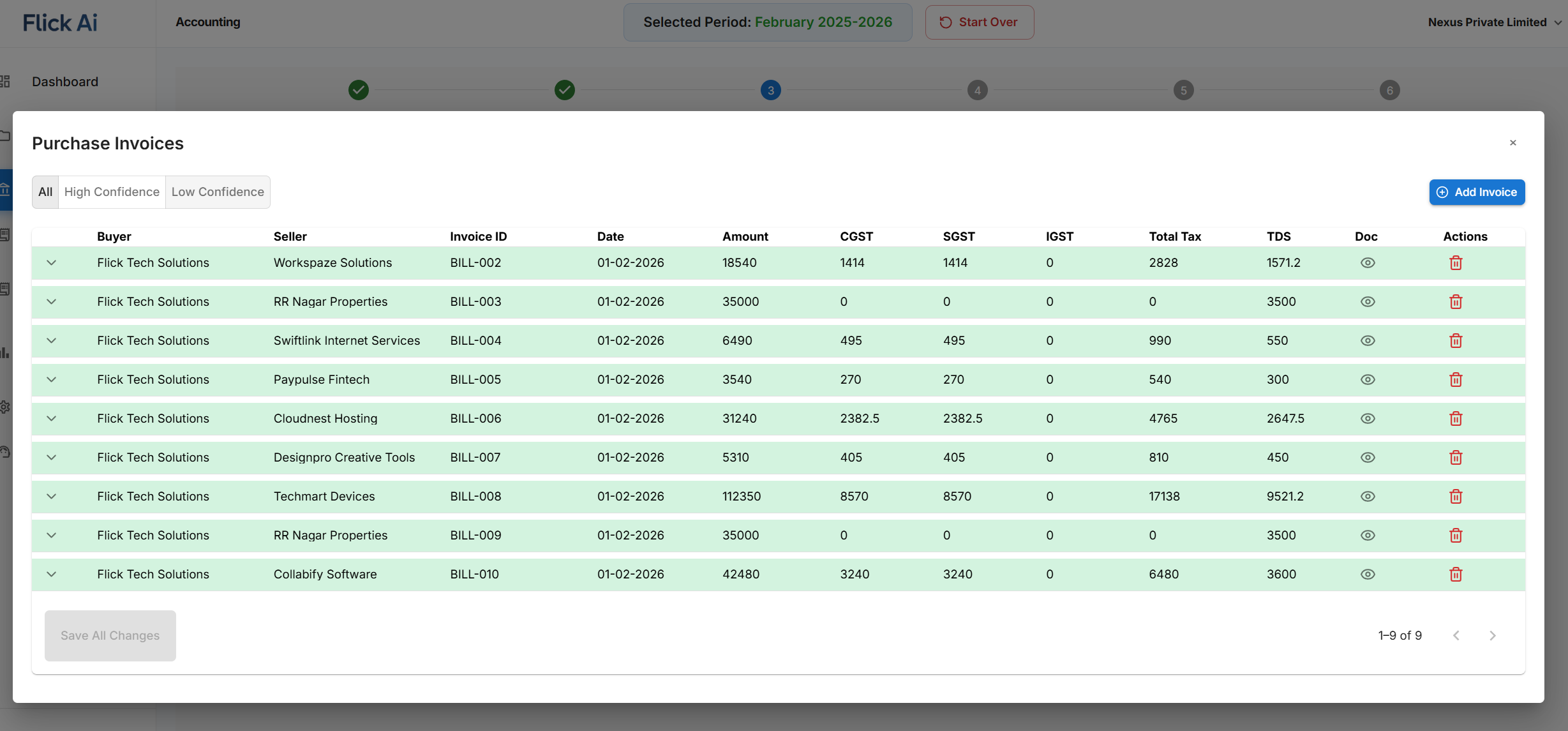
For each vendor invoice, Flick AI extracts the mandatory GST fields: supplier GSTIN, invoice number, invoice date, place of supply, HSN/SAC codes, taxable values, and tax amounts (CGST, SGST, IGST separately). The extracted GSTIN is validated against the GSTN database. Invoices with invalid or inactive GSTINs are flagged immediately because ITC on those invoices is at risk.
Step 3: Identify and flag RCM transactions
Transactions that qualify for Reverse Charge Mechanism are identified based on supplier registration status, service category, and supply type. RCM entries which don't appear on invoices as charged tax but must be self-assessed and paid are created as draft entries for finance team review and approval before posting. Businesses managing large invoice volumes can also explore our AI Invoice Parsing Software workflows to improve document processing efficiency.
Step 4: Monthly GSTR-2B reconciliation
On the 14th of each month, GSTR-2B is available on the GST portal. Flick AI compares GSTR-2B data against purchase records automatically, identifying invoices in your books that aren't in GSTR-2B (supplier hasn't filed), and invoices in GSTR-2B that aren't in your books (missed invoices). This list drives follow-up with suppliers and ensures ITC claims are defensible. Businesses seeking stronger transaction matching workflows may also benefit from Automated Bank Reconciliation Software processes.
Step 5: Calculate GST liability and ITC position
Output GST on sales (from GSTR-1 data) minus eligible ITC on purchases (from reconciled GSTR-2B data) gives the net GST payable for the period. This calculation is available as a report before the GSTR-3B filing deadline, giving finance teams time to verify the numbers rather than rushing the calculation on the due date.
Step 6: Maintain GSTR-9-ready records throughout the year
Annual GST returns require reconciling everything filed during the year with the audited books. When GST data is maintained accurately throughout the year — with GSTR-2B reconciled monthly and RCM entries tracked continuously — GSTR-9 preparation becomes a verification exercise rather than a reconstruction exercise. As part of a wider AI Accounting Software ecosystem, Flick AI helps businesses improve financial visibility while reducing the administrative burden associated with GST accounting.
Product proof
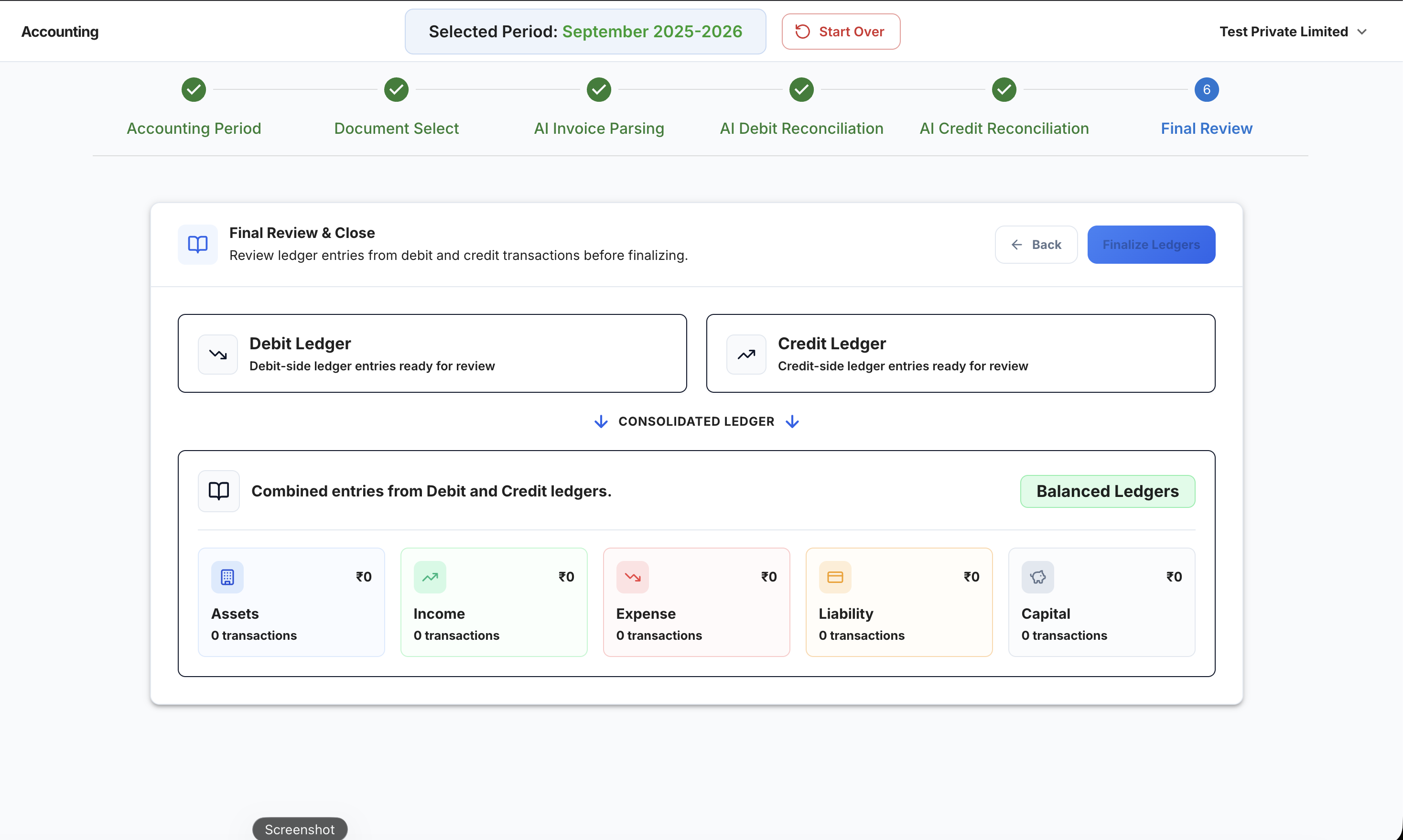
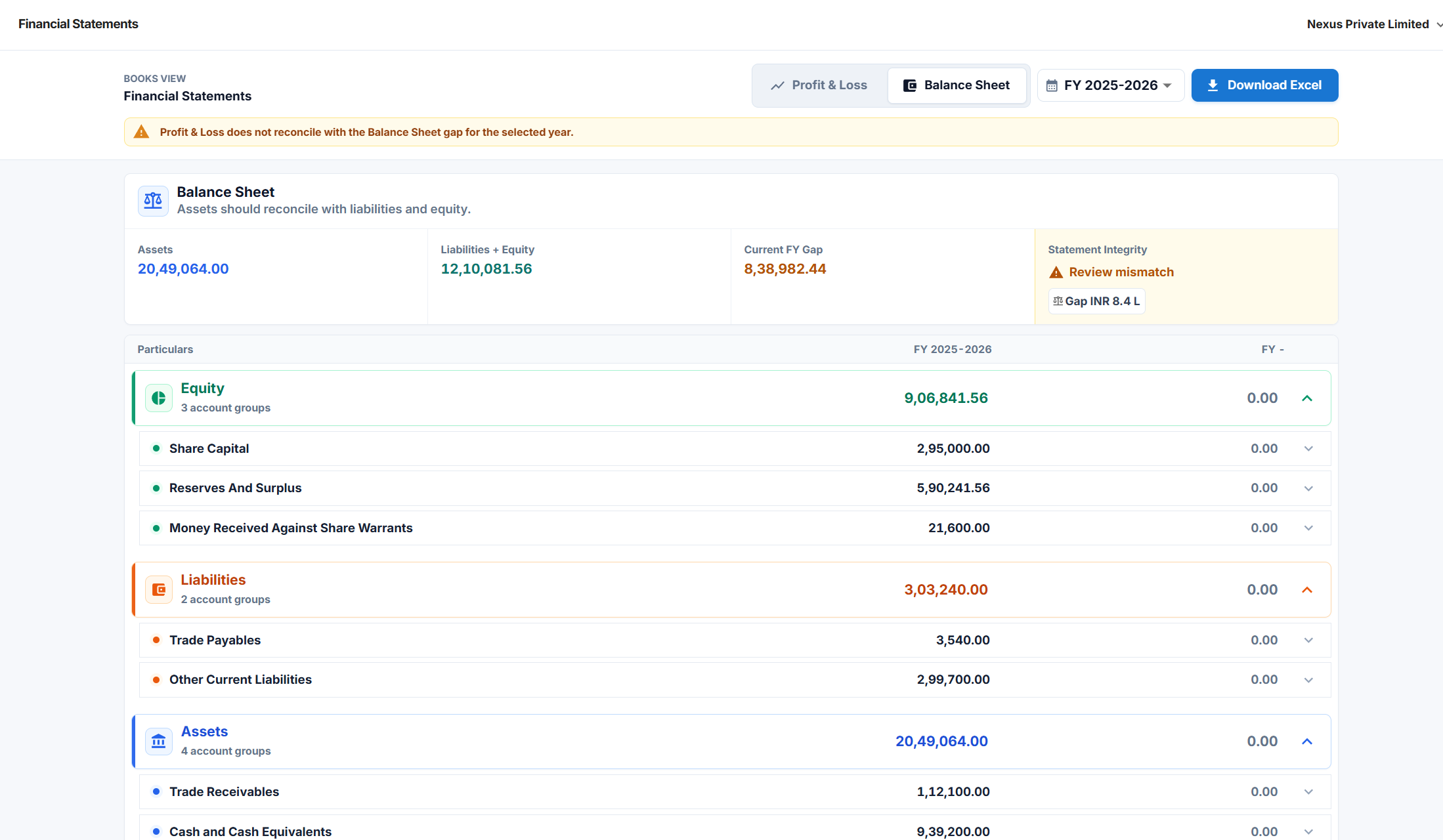
Screens from the Flick AI workflow
.png)
.png)
GST Accounting for Different Business Types
GST requirements can vary significantly depending on how a business generates revenue, manages customers, and processes transactions. While the underlying GST framework remains the same, the operational challenges businesses face often differ based on their business model.
Service Businesses
Service businesses typically manage project-based billing, retainers, milestone payments, recurring invoices, and professional service engagements. GST accounting often requires accurate tracking of customer invoices, payment receipts, advances, and outstanding receivables. As the number of clients increases, maintaining accurate records and ensuring consistency across invoices, collections, and GST reporting can become increasingly important. Businesses that process a large number of invoices often benefit from structured bookkeeping and invoice management workflows.
Product and E-commerce Businesses
Product-based and e-commerce businesses frequently manage higher transaction volumes, multiple GST rates, inventory-related transactions, marketplace sales, returns, refunds, and payment gateway settlements. GST accounting can become more complex when businesses sell across different states, platforms, and customer segments. Maintaining accurate transaction records and reconciling sales, returns, and GST liabilities often requires strong accounting and reconciliation processes.
SaaS and Subscription Businesses
SaaS businesses often operate recurring billing models with monthly, quarterly, or annual subscription plans. GST accounting may involve managing recurring invoices, subscription renewals, customer upgrades, refunds, and payment gateway collections. As subscription volumes increase, maintaining consistency across billing records, collections, and GST-related reporting becomes increasingly important for accurate financial management.
Businesses with B2B and B2C Transactions
Businesses serving both B2B and B2C customers frequently face additional GST accounting complexity. B2B transactions often require detailed GST information and Input Tax Credit considerations, while B2C transactions may involve high transaction volumes, multiple payment methods, and different reporting requirements. Managing both customer segments simultaneously requires accurate transaction classification, organized record keeping, and reliable reconciliation processes to maintain compliance readiness.
GST Audit and Assessment Preparation
The most stressful scenario in GST compliance is an assessment or scrutiny notice from the GST department. These notices are triggered by discrepancies between GSTR-1 and GSTR-3B, ITC claims that exceed GSTR-2B limits, mismatches between turnover reported in GST and income tax returns, or random selection for scrutiny.
What GST Authorities Typically Ask For
When a business receives a GST scrutiny notice (typically under Section 61 of the CGST Act for scrutiny of returns), the authorities may ask for: all purchase invoices corresponding to ITC claimed, bank statements reconciled with books, a reconciliation statement between books of accounts and GST returns, and explanations for any specific transactions flagged. Businesses that maintain organized, reconciled records can respond to these requests within a few days. Businesses with disorganized records spend weeks reconstructing documentation.
The Role of Accounting Software in Assessment Response
GST accounting software that maintains a complete, timestamped audit trail — every transaction, every ITC claim, every GSTR-2B match — becomes the primary evidence in responding to GST assessment. The ability to produce a transaction-level reconciliation showing: "this ITC was claimed on this invoice, which matches this GSTR-2B entry from this supplier" is the difference between a resolved notice and an extended proceeding.
Key GST Metrics and Compliance Checkpoints
Successful GST management is not limited to filing returns on time. Businesses that maintain strong GST processes typically monitor key compliance metrics throughout the month to identify issues early, improve reporting accuracy, and reduce reconciliation effort before filing deadlines arrive.
Monthly GST Liability
Monthly GST liability represents the total GST payable by the business after considering taxable outward supplies and applicable adjustments. Monitoring GST liability regularly helps businesses understand upcoming tax obligations, plan cash flows more effectively, and avoid surprises during return preparation. Consistent tracking also improves visibility into the impact of sales growth, changing transaction volumes, and seasonal business fluctuations on GST obligations. Strong GST tracking is often part of a broader AI Accounting Software strategy focused on financial visibility and reporting readiness.
Input Tax Credit (ITC) Available vs Claimed
Input Tax Credit is one of the most important GST metrics for businesses. Finance teams should regularly compare eligible ITC available in records against ITC claimed in returns. Differences may indicate missing invoices, supplier reporting delays, incorrect classifications, or reconciliation issues. Monitoring this metric helps businesses maximize eligible credits while reducing the risk of compliance-related discrepancies. Accurate invoice capture through AI Invoice Parsing Software can help improve ITC tracking and documentation quality.
GSTR-2B Reconciliation Status
GSTR-2B reconciliation helps businesses verify whether purchase records and supplier-reported transactions align with available GST data. Regular reconciliation enables finance teams to identify mismatches, missing invoices, supplier compliance issues, and potential Input Tax Credit risks before returns are filed. Monitoring reconciliation status throughout the month often reduces last-minute compliance pressure. Many businesses combine GST reviews with Automated Bank Reconciliation Software workflows to improve overall reconciliation accuracy.
Pending Filings and Compliance Deadlines
Tracking upcoming GST filing deadlines is essential for maintaining compliance. Businesses should maintain visibility into pending returns, filing schedules, reconciliation activities, and supporting documentation requirements. Monitoring compliance readiness before deadlines helps reduce filing delays and ensures that GST-related records remain complete and accurate throughout the reporting cycle.
Signs Your Current GST Process Needs Improvement
Many businesses do not realize their GST processes are becoming inefficient until compliance activities begin consuming significant finance team time. If several of the situations below sound familiar, it may be a sign that your business needs a more structured approach to GST accounting and compliance management.
GST data is maintained across multiple spreadsheets and systems.
Input Tax Credit reconciliation requires significant manual effort every month.
GSTR-2B mismatches are frequently identified close to filing deadlines.
Finance teams spend considerable time collecting invoices before preparing returns.
Vendor invoice discrepancies regularly delay ITC validation.
GST classifications are reviewed manually for a large number of transactions.
Month-end accounting and GST reconciliation activities overlap and create reporting bottlenecks.
Multiple team members maintain separate GST records or working files.
GST-related reports require substantial manual preparation before filing.
Filing deadlines create last-minute pressure on finance and accounting teams.
GST reconciliation issues are often discovered only during return preparation.
Business growth has increased invoice volumes, vendor transactions, and GST complexity beyond what existing processes can comfortably handle.