
What Makes Accounting Complex for Indian Businesses Specifically
Accounting for an Indian business is fundamentally different from what it was five years ago and very different from accounting in the US or UK markets where most software was designed.
Indian businesses today collect payments across at least four or five channels simultaneously: NEFT/RTGS bank transfers, UPI (which alone can generate hundreds of small daily transactions), payment gateways like Razorpay, Cashfree, or PayU, marketplace settlements from Amazon or Flipkart, and cash. Each channel settles differently, charges fees differently, and arrives in bank statements in different formats.
At the same time, GST compliance requires every transaction to be classified correctly not just for filing, but for Input Tax Credit (ITC) reconciliation, GSTR-2B matching, and audit readiness. A miscategorized transaction isn't just a bookkeeping error; it's a compliance risk.
Then there's the India-specific operational reality: many businesses rely on a mix of Tally entries, WhatsApp invoice sharing, Excel reconciliation sheets, and CA-prepared quarterly reports. These tools don't talk to each other. Finance teams end up doing the same work three times across three systems.
AI accounting software addresses all of this by creating a single automated workflow from invoice capture to bank reconciliation to GST-ready reporting that was built for how Indian businesses actually operate.
This complexity isn't theoretical. Working with businesses across manufacturing, SaaS, e-commerce, retail, and professional services, we consistently see finance teams spending the first 8–10 working days of every month collecting and organizing the previous month's data — before a single line of actual accounting work begins. The accounting isn't slow. The data pipeline feeding it is.
Signs Your Current Accounting Workflow Is Costing You
Most businesses don't switch accounting workflows because of a crisis. They switch because of slow accumulation of small frustrations that eventually consume significant time.
We've spoken with founders and finance heads across more than 200 Indian businesses in the last two years. The triggers below aren't hypothetical, they're the specific moments people describe when they tell us why they started looking for a better solution.
Here are the signs that manual processes are holding you back:
Your Razorpay settlement report takes more than 2 hours to reconcile each week
Your CA receives your books 10–15 days after month-end because data collection is still manual
You don't know your current outstanding receivables without opening three different spreadsheets
GST filing preparation involves pulling invoices from email, WhatsApp, and a shared drive
You've processed a duplicate vendor payment in the last six months because payables weren't centralized
UPI collections are categorized as a lump sum rather than matched to individual invoices
Your month-end close has taken more than 5 working days in at least 3 of the last 6 months
Your CA flags the same missing or incomplete invoices every quarter, and the answer is always "we'll track it better next month"
Founders ask the finance team for a cash position update and the answer takes more than a day
Who Flick AI Is For, and Who Should Not Use It Yet
The best AI accounting software is not the one with the longest feature list. It is the one that fits the shape of your accounting month. Flick AI is strongest when invoices, bank statements, payment collections, GST/TDS review, ledgers, and founder reports need to move through one repeatable workflow.
Good fit
Indian startups that need cleaner books for founder review, investor updates, and CA handoff.
Service businesses, agencies, consultants, and SaaS teams with recurring invoices and monthly bank reconciliation.
Invoice-led SMEs that want reviewable AI invoice parsing, bank matching, and financial reports without building spreadsheets around every process.
Not the first choice yet
Businesses whose main accounting complexity is heavy inventory, manufacturing costing, or warehouse operations.
Teams looking for AI to auto-file taxes without CA or finance review.
Very early businesses with only a handful of transactions where a spreadsheet and CA review are still enough.
AI Accounting Software vs Traditional Accounting: The Key Differences
The differences go beyond automation speed — they affect how quickly founders can make decisions, how accurately GST ITC is tracked, and how much of the finance team's time goes to analysis versus data entry. See the full comparison: AI Accounting Software vs Traditional Accounting
How AI Accounting Software Fits Into Your Finance Stack
AI accounting software doesn't replace your CA or your accounting system. It sits between your raw financial data and your accounting records, doing the work that currently happens manually, the work that consumes 60–70% of a finance team's time without requiring any of their actual expertise.
Most businesses we work with have the right people. They just have those people doing the wrong tasks. Here's how the full workflow connects, and where AI takes over:
Layer 1 — Document Ingestion
Every accounting workflow starts with documents: purchase invoices, vendor bills, bank statements, payment gateway settlement reports, expense receipts, and credit notes. In most businesses, these arrive through different channels email, WhatsApp, supplier portals, bank downloads and need to be manually organized before accounting can begin. AI accounting software centralizes this ingestion step, accepting documents in multiple formats (PDF, scanned images, Excel exports) and creating a single input layer.
Layer 2 — Data Extraction and Structuring
Raw documents contain unstructured data. A PDF invoice from a vendor doesn't automatically become a ledger entry, someone has to read it and type the values in. AI extraction (which goes beyond basic OCR) reads the document, identifies the relevant fields (invoice number, GSTIN, taxable value, GST amount, line items), and converts them into structured accounting data. For a business processing 300 invoices a month, this single layer typically saves 18–25 hours of data entry work monthly. How AI invoice parsing works
Layer 3 — Reconciliation
Extracted data still needs to be matched, invoices matched to bank credits, payments matched to vendor bills, UPI collections matched to customer invoices. Automated reconciliation handles routine matching (exact amounts, known vendors) and flags exceptions (partial payments, unmatched entries, timing differences) for human review instead of requiring manual review of everything. In practice, automated matching typically resolves 85–92% of transactions without any human input, leaving a review queue of 8–15% that genuinely needs judgment. How automated bank reconciliation works
Layer 4 — Classification and Bookkeeping
Once transactions are matched, they need to be classified into ledger accounts, cost centers, and GST categories. AI-assisted classification suggests the appropriate treatment based on transaction type, vendor, and historical pattern reducing manual categorization from hours to minutes of review. How AI bookkeeping software works
Layer 5 — Reporting and Compliance Outputs
With structured, reconciled, classified data, generating reports — P&L, balance sheet, receivables aging, GST liability summary — becomes a pull rather than a push. Reports are available when needed, not after a multi-day data collection process. How GST accounting software works
Common Accounting Challenges Solved By AI
Manual Bank Reconciliation
For Indian businesses, reconciliation is uniquely complex because of how fragmented payment collection has become. A mid-sized business receiving 300 orders a month might collect via Razorpay (with T+2 settlement batches), UPI (individual transactions), NEFT (bulk transfers), and sometimes cash deposits. Each channel has a different settlement cycle, different fee deduction structure, and different export format. Manually matching these against accounting records typically takes 2–4 working days per month time that increases proportionally as transaction volumes grow. Automated reconciliation reduces this to exception review, which typically takes 2–4 hours.
Delayed Financial Reporting
The typical reporting delay in growing Indian businesses isn't caused by slow accountants — it's caused by a data collection problem. Before a P&L can be prepared, someone has to collect bank statements from multiple accounts, download settlement reports from each payment gateway, gather vendor invoices from email and WhatsApp, and import payroll data. This data collection step often takes 5–7 working days. AI accounting software eliminates most of this by keeping data organized as it flows in, so report generation becomes hours rather than days.
Receivables and Payables Tracking
The receivables problem in most growing Indian businesses is less about not sending invoices and more about not knowing which invoices are outstanding at any given time. When customers pay via UPI or NEFT with incomplete payment references, matching the payment to the invoice requires manual investigation. When sales happen across multiple channels (direct, marketplace, distributor), a consolidated receivables view doesn't exist unless someone builds it manually in Excel. AI accounting systems that automatically match collections to outstanding invoices give finance teams and founders a real-time AR position without any manual work.
Invoice Management
Indian businesses deal with a specific invoice complexity that most global software ignores: the mandatory GST invoice fields. Every B2B purchase invoice needs to capture the supplier's GSTIN, the HSN/SAC code, the GST rate applied, and the taxable value separately from the GST amount — because these values drive ITC eligibility. When invoices are manually entered, this data is often incomplete or inconsistently recorded. AI invoice processing captures all mandatory GST fields automatically and flags invoices with missing compliance information before they enter the books. How AI Invoice Parsing Software works
Accounting Bottlenecks During Growth
The pattern we observe consistently: a business at ₹2–5 crore ARR manages accounting with 1 internal person and a CA firm. At ₹10–15 crore, the same structure is still in place, but the internal person is now spending 80% of their time on data entry and reconciliation instead of financial analysis. The bottleneck isn't headcount, it's that the workflow was never designed to handle 10x the transaction volume. Hiring a second finance person solves capacity temporarily; AI accounting software restructures the workflow so the same team can handle 10x the volume.
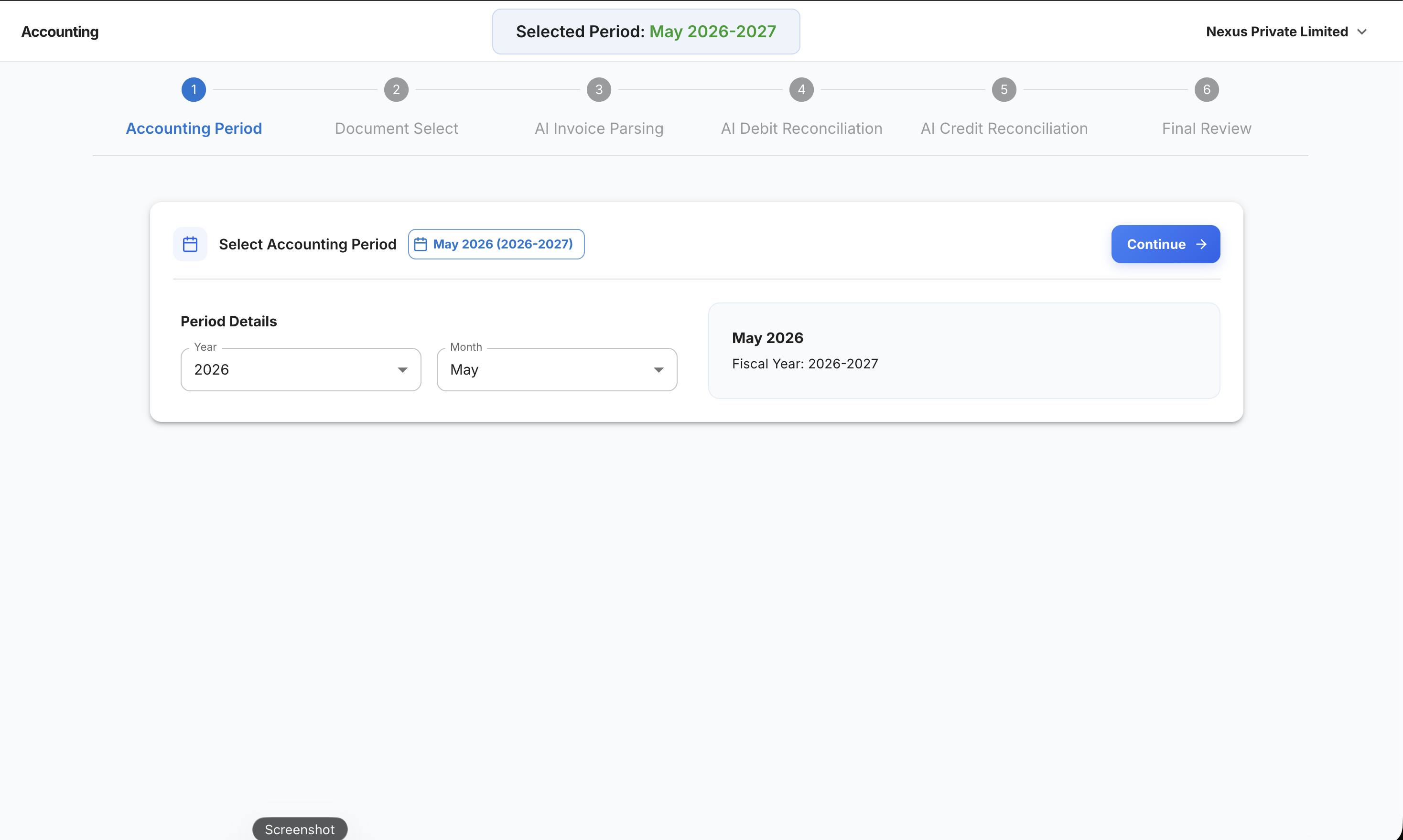
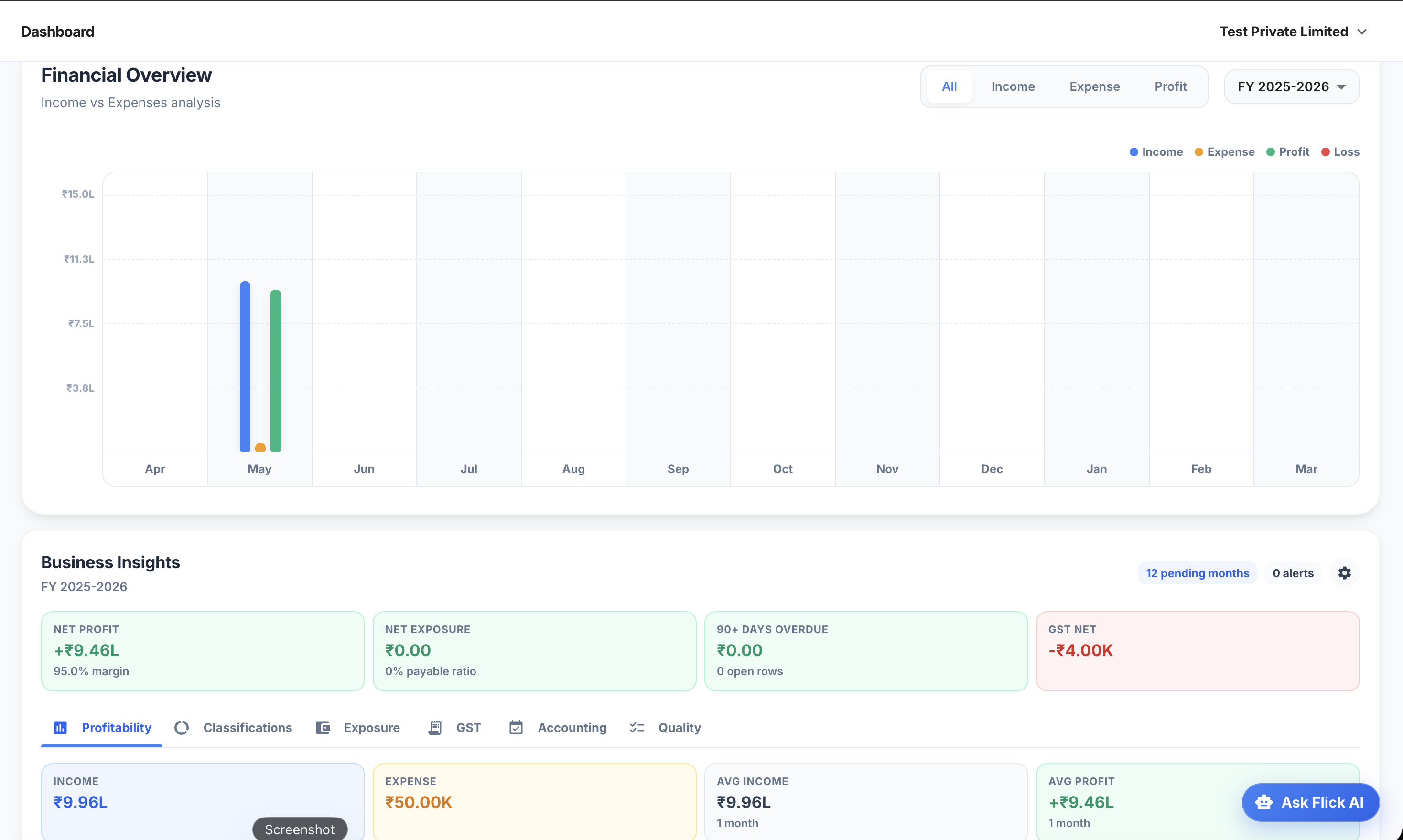
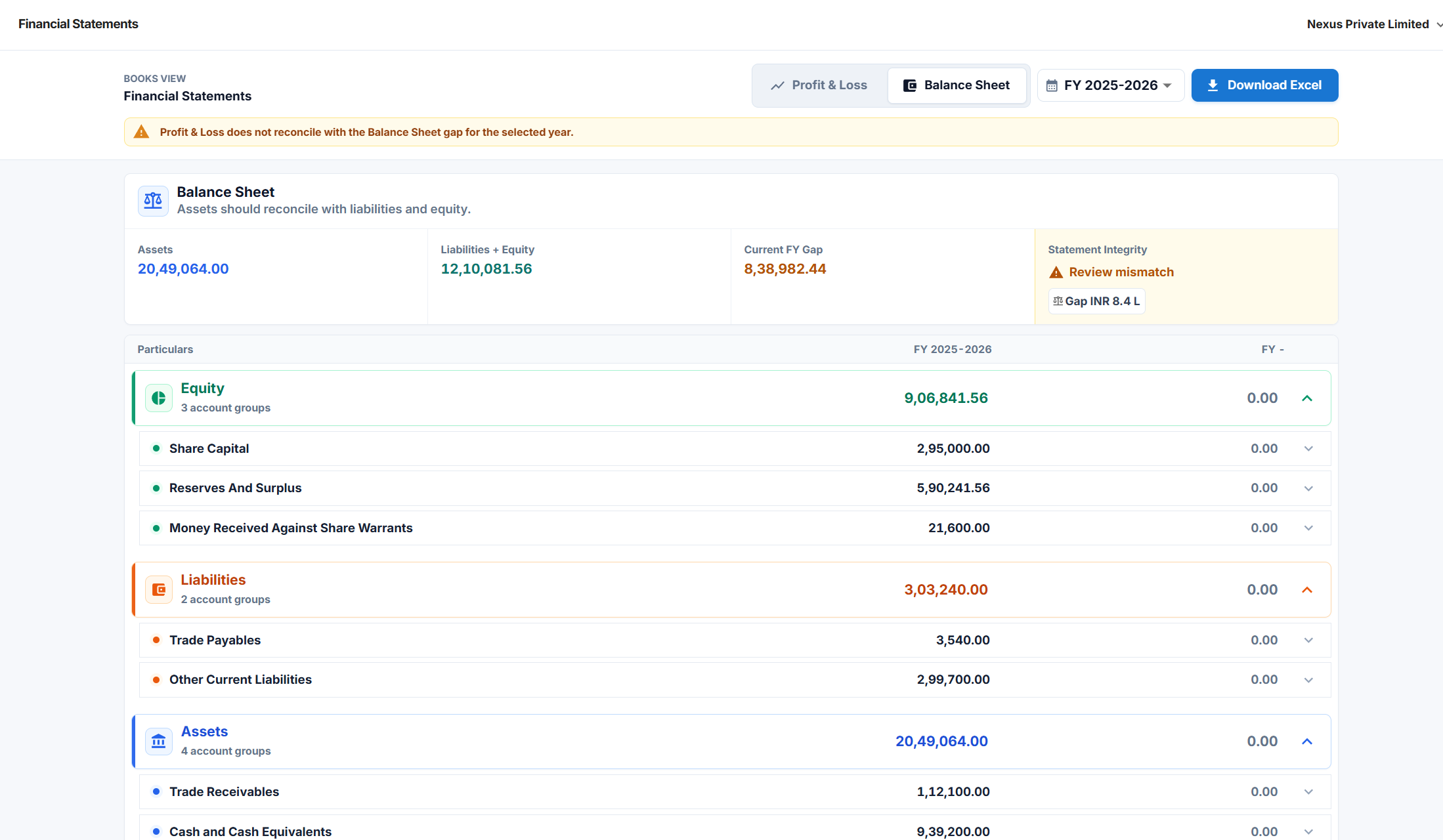
Product proof
Screens from the Flick AI workflow
How to Evaluate AI Accounting Software: What to Look For
Not all AI accounting platforms are built the same and the gaps between them are most visible in India-specific scenarios that generic software wasn't designed for. Most platforms handle the easy cases well (a clean PDF invoice from a large vendor, a single bank account). The differences show up in edge cases that are actually very common for Indian businesses: UPI narrations with no customer identifier, payment gateway settlements with returns netted off, vendors without active GSTINs, e-invoices with QR codes that need IRN validation.
Here's what to check specifically when evaluating any platform for an Indian business:
India-Specific Payment Channel Support
Check whether the platform handles UPI reconciliation natively not just bank statement import. UPI transactions appear differently in bank statements (with varying narration formats across banks) and require specific matching logic. Similarly, check whether Razorpay, Cashfree, and PayU settlement reports can be processed automatically.
GST Compliance Depth
A platform that categorizes transactions isn't the same as one that captures GST-compliant invoice data. Verify whether the platform captures GSTIN, HSN/SAC codes, GST rates, and taxable values at the line-item level because these are the inputs required for ITC reconciliation and GSTR filing.
Human Review Controls
AI accounting software should reduce manual work, not eliminate human judgment. Look for platforms that flag exceptions for review rather than auto-posting everything especially for high-value transactions, new vendors, and GST mismatches.
CA/Auditor Output Compatibility
Check what the platform exports. Does it produce Tally-compatible outputs? Can an auditor access a clean trial balance and ledger? Can a CA prepare GSTR-1 from the platform's data without re-entering anything?
Scalability Without Configuration Overhead
Some platforms require significant setup for each new bank account, vendor, or payment channel. As businesses grow, this configuration debt becomes a bottleneck. Look for platforms that learn from existing data rather than requiring manual rule-building for every new scenario.
What Founders Actually Need From Accounting Software
Most founders don't want to become accountants. They want four things: to know how much cash they have right now, to know who owes them money and when it's coming, to know what they're spending and whether it's in line with plan, and to not be surprised by the CA at quarter-end with a list of missing invoices and unexplained transactions.
AI accounting software serves founders not by giving them more dashboards, but by eliminating the 5–7 day lag between financial events happening and founders knowing about them. When bank reconciliation runs automatically and invoices are processed as they arrive, the financial position is always current.
The three reports founders look at most — cash position, receivables aging, and burn rate and these should be available on demand, not prepared on request.
The founders we work with across SaaS, D2C, and services businesses are unanimous on one thing: they don't want more financial data. They want faster answers to four questions: what's in the bank right now, who owes us money and when, what are we spending, and are we on track. Every other financial report is secondary to those four. AI accounting software that keeps books current makes those answers available without any preparation time.
AI Accounting Software for CA Firms
CA firms face a different problem: they're doing bookkeeping for multiple clients, each with different systems, different transaction volumes, and different document delivery habits. A client who sends a WhatsApp forward of each invoice, a client who uses Tally, and a client who sends a monthly Excel dump all create different manual workloads.
AI accounting automation helps CA firms standardize input processing regardless of how a client delivers documents, the extraction and structuring workflow is the same. This reduces per-client bookkeeping time and allows firms to handle more clients without hiring proportionally.
The highest-value shift: when routine bookkeeping is automated, CA time moves from data entry to review, advisory, and compliance, the work clients actually pay premium rates for.
In our experience working with CA firms handling 15–40 business clients, the firms that adopt AI bookkeeping tools typically reduce their per-client bookkeeping time by 40–60% without any reduction in review quality, because reviewers are working from cleaner, more consistently organized data.
AI Accounting Software for Startups
Indian startups face an accounting challenge that's specific to how they operate: they grow fast, add payment channels quickly, start receiving investor scrutiny before their books are organized, and often discover during due diligence that their financial records have gaps going back 12–18 months.
The businesses that handle fundraising most efficiently are almost always the ones that maintained clean, reconciled books throughout not because they anticipated due diligence, but because their accounting workflow was organized enough that producing 18 months of management accounts was a 2-day exercise, not a 3-week reconstruction project.
What We've Learned Working With Indian Finance Teams
The reconciliation pattern:
The businesses that come to us are rarely struggling because their accountants aren't good at their jobs. They're struggling because the workflow was designed for 80 transactions a month and is now handling 600 and nobody stopped to redesign it in between. The typical picture: a Razorpay integration added 18 months ago that's never been reconciled properly, UPI collections that get batched and entered as a single lump sum each week, and a vendor base that grew from 8 to 35 without any change to how invoices are processed.
When we do the first month's reconciliation with a new client, we almost always find the same thing: 3–6 months of unreconciled UPI collections sitting in a suspense account or categorized as "other income." On average, across the businesses we've onboarded, the backlog cleanup in the first month takes 12–18 hours of organized work, work that would have taken 2–3 hours per month if it had been done continuously.
The founder visibility pattern:
The most common thing founders tell us isn't "I don't understand finance." It's "I called my finance person at 9pm on a Tuesday to ask what our current bank balance was, and she had to check manually and call me back." That's a bookkeeping lag problem, not a reporting problem.
We've seen this pattern across founders managing businesses from ₹2 crore to ₹30 crore in revenue: the delay between a financial event (a large payment received, a major expense cleared, a customer invoice going overdue) and the founder knowing about it is typically 3–7 days. In fast-moving businesses where decisions about hiring, inventory, or vendor commitments happen weekly, a 5-day financial information lag is a genuine operational handicap.
When books are current reconciled daily rather than monthly, the same founder can open a dashboard at 9pm on a Tuesday and answer their own question in 30 seconds.
The GST pattern:
We see the same GST situation repeatedly: a business that has been claiming ITC correctly for two years discovers, during CA-led GSTR-9 preparation, that 15–20% of their purchase invoices have incomplete or missing GSTIN data. The ITC was claimed. The documentation doesn't support it. That's a retrospective liability that could have been caught at entry time with basic invoice validation.
The growth inflection pattern:
There's a consistent inflection point: somewhere between ₹3 crore and ₹8 crore in annual revenue, the accounting workflow that worked fine at ₹1 crore starts breaking. Not catastrophically just slowly, with more delays, more catch-up work before filing dates, more time the founder spends chasing financial information instead of making decisions. That's usually when businesses find us.