
What Is AI Bookkeeping Software?
Accounting and bookkeeping are often used interchangeably, but they're different activities with different bottlenecks.
Accounting is the higher-level function: financial analysis, reporting, compliance, tax planning. Bookkeeping is the foundational work underneath it: recording every transaction, categorizing every expense, reconciling every bank entry, maintaining every ledger. Without accurate, up-to-date bookkeeping, accounting cannot happen.
In most Indian businesses below ₹20–25 crore in revenue, the "bookkeeper" is either the founder themselves, a junior finance team member, or the CA firm that handles it as part of a bundled retainer. In any of these cases, bookkeeping is manual: transactions are entered one by one, bank statements are reviewed line by line, categories are assigned based on memory and judgment.
The bottleneck is rarely capability, it's volume. A person who can maintain accurate books for 80 transactions a month is the same person who struggles with 600 transactions a month, not because they're less capable, but because the process doesn't scale.
AI bookkeeping software addresses this volume bottleneck specifically not by replacing the judgment of a bookkeeper, but by automating the mechanical work of capturing, organizing, and categorizing transactions so that human effort goes to review and correction rather than data entry.
The Three Bookkeeping Tasks That Break First as You Grow
Not all bookkeeping tasks become difficult at the same rate. When we look at where finance teams lose the most time as transaction volumes increase, three activities account for roughly 70–80% of the manual work.
Transaction Categorization
Every transaction that enters the books needs to be assigned to a ledger account: salaries, rent, marketing spend, SaaS subscriptions, vendor payments, customer collections, bank charges, GST paid, GST received. When there are 50 transactions a month, this takes minutes. At 500 transactions, it takes hours and the error rate increases as the person doing the work moves faster to get through the volume. AI categorization learns from existing books and correctly classifies recurring transactions automatically, flagging unusual entries for human review.
Bank Statement Matching
A bank statement entry that says "UPI/9886XXXXXX/HDFC" doesn't tell you who paid, which invoice it relates to, or how to categorize it. Resolving that entry requires looking up the phone number, finding the customer, identifying the invoice, and matching the amount. For 10 such entries, this is manageable. For 200 entries a month (common for any business with active UPI collections), it's a half-day exercise. Automated matching resolves known senders instantly and queues unknowns for review rather than forcing manual processing of every line.
Month-End Close Preparation
Month-end close requires confirming that every transaction is recorded, every bank entry is matched, every vendor invoice is entered, and every outstanding item is accounted for. In manual bookkeeping, this involves a checklist that gets worked through manually often over 3–5 working days. With automated bookkeeping, transactions are processed as they arrive throughout the month, so month-end close becomes a verification exercise (reviewing exceptions and finalizing adjustments) rather than a data collection exercise.
How Daily Bookkeeping Works With AI
Unlike accounting or reporting workflows that happen periodically, bookkeeping is a daily activity or should be. Transactions happen every day. Invoices arrive every day. Bank entries are posted every day. The advantage of AI bookkeeping is that it processes these daily inputs as they arrive, so books are never more than a day behind.
Step 1: Document capture: Invoices and bills as they arrive
Instead of batching documents for weekly or monthly entry, invoices and bills are uploaded or forwarded as received. This can happen via direct upload, email forwarding, or integration with accounting systems. The earlier documents enter the workflow, the more current the books stay.
Step 2: Automated line-item extraction
Each invoice is read at the field level: vendor name, invoice date, invoice number, line items with HSN/SAC, taxable value, GST rate, GST amount, total. This isn't OCR (which converts images to text) — it's structured data extraction that understands invoice formats and pulls values into accounting fields directly. Businesses looking to automate document processing can also explore our AI Invoice Parsing Software to understand how invoice data extraction can further streamline bookkeeping workflows.
Step 3: Ledger categorization with learning
Extracted transactions are categorized into the appropriate ledger accounts operating expense, purchase, salary, marketing, infrastructure based on vendor patterns and historical categorizations. New vendors or unusual transactions are queued for review. The system improves categorization accuracy as it processes more transactions from the same business. Consistent categorization also supports faster matching of financial records and improves downstream processes such as Bank Reconciliation Software workflows, where transaction accuracy is critical.
Step 4: Bank entry matching
When a bank credit arrives (from UPI, NEFT, gateway settlement), it's matched to an outstanding receivable. When a bank debit occurs, it's matched to an approved vendor bill or categorized as an operating expense. Unmatched entries are flagged not ignored.
Step 5: Bookkeeper review queue
The bookkeeper or finance lead sees only what needs attention: new vendors, unusual amounts, entries that don't match any pattern, transactions above a threshold. Instead of reviewing 500 transactions, they review 25–40 exceptions. This is where human judgment adds value, the AI handles what it knows, humans handle what it doesn't. Businesses exploring modern Startup Accounting Software solutions often prioritize bookkeeping automation as one of the first steps toward scalable financial management.
Step 6: Always-current books
Because transactions are processed daily, the ledger is always up to date. When a founder asks for current outstanding receivables or yesterday's cash position, it's already in the system, no report needs to be "prepared.". These bookkeeping processes form an important part of a broader AI Accounting Software ecosystem that helps automate accounting operations and improve financial management across the organization.
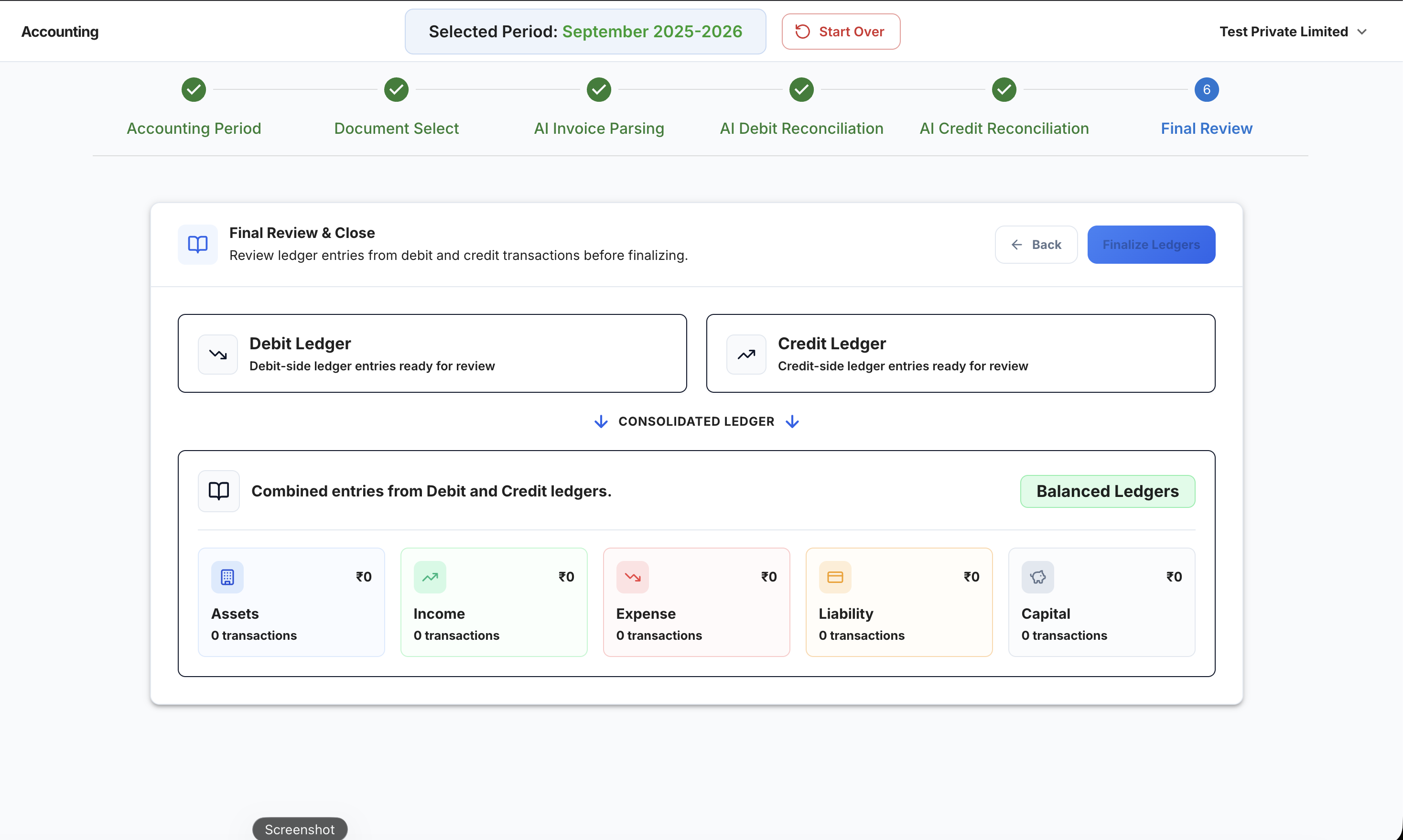
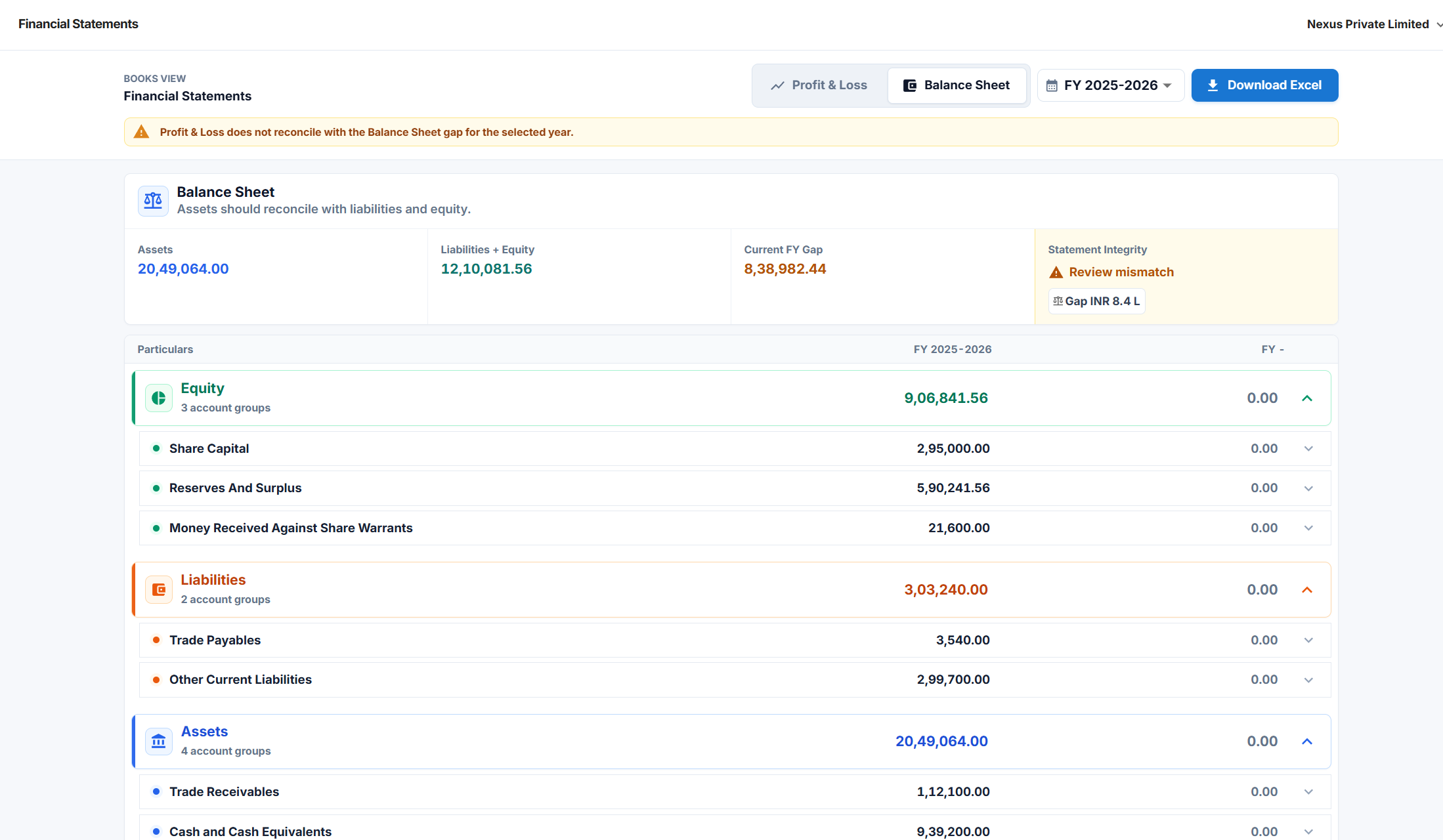
Product proof
Screens from the Flick AI workflow
.png)
Key Benefits of AI Bookkeeping Software
As businesses grow, bookkeeping processes often become more time-consuming and difficult to manage. AI Bookkeeping Software helps automate routine bookkeeping activities, improve record management, and reduce the administrative effort required to maintain accurate financial records. Below are some of the key benefits businesses experience when adopting bookkeeping automation.
Faster Bookkeeping
The speed gain is concentrated in one step: eliminating the document-to-ledger-entry gap. A vendor invoice that takes 4–6 minutes to manually read, validate, and enter becomes a seconds-long extraction and categorization. For a business processing 250 invoices a month, this single change reduces bookkeeping time by 15–20 hours monthly before even accounting for bank matching and reconciliation savings. For cloud bookkeeping software built for Indian businesses, this speed improvement is most visible at month-end, when the data is already organized rather than being collected and entered simultaneously.
Reduced Manual Effort
In a typical manual bookkeeping setup at a business processing 400–500 transactions per month, data entry and reconciliation account for 55–65% of the finance team's productive working hours. This isn't because the team is inefficient, it's because every transaction requires a human to read, classify, and record it. AI bookkeeping automation shifts this ratio significantly: the same team spends 15–20% of their time on data entry (reviewing exceptions and approving categorizations) and 80–85% on analysis, reporting, and financial management. The work that actually requires their expertise gets the majority of their time.
Consistent Transaction Categorization
Inconsistent transaction categorization is one of the most common and least-noticed bookkeeping problems. When two different people are categorizing transactions or when one person does it under time pressure at month-end versus carefully at the start of the month the same type of transaction can be classified differently over time. A software subscription paid to AWS might appear as "infrastructure," "cloud services," or "IT expenses" in different months, making expense analysis unreliable. AI bookkeeping software applies the same classification logic to every instance of the same transaction, across every month, regardless of who is reviewing. For Indian businesses claiming ITC, consistent GST categorization also directly affects the accuracy of ITC calculations, a transaction classified in the wrong ledger group may have its GST treatment applied incorrectly.
Improved Financial Organization
Disorganized financial records create problems that aren't visible until they're expensive to fix. The most common scenario: a business that needs to produce 18 months of clean management accounts for investor due diligence, and discovers that 6 months of records exist in three different places some in Tally, some in Excel, some in the CA's working files with inconsistent categorizations across all three. Reconstructing those records into a coherent set of management accounts has taken businesses we've worked with anywhere from 10 to 30 additional hours, at a point when the investor timeline doesn't allow for delays. Organized bookkeeping where records are current, consistently categorized, and maintained in one system eliminates this reconstruction risk entirely.
Better Reporting Readiness
The practical test of reporting readiness: can your finance team produce a P&L, balance sheet, and cash flow statement for the current month not last month, the current month within 24 hours of being asked? In a manual bookkeeping setup, the answer is almost always no, because the books aren't current enough. There's always a lag: unprocessed invoices, unmatched bank entries, pending categorization reviews. In an AI bookkeeping setup where documents are processed as they arrive and bank entries are matched daily, the same reports are available within hours because the underlying records are current rather than 2–3 weeks behind. For businesses producing monthly MIS reports for investors or management, this reporting readiness is the most immediate practical benefit.
Scalable Bookkeeping Processes
The scalability problem with manual bookkeeping is mathematical: every additional transaction requires roughly the same amount of human time to process. A business that grows from 200 to 1,000 monthly transactions needs to either find 5x the bookkeeping time or accept that records will fall further and further behind. Neither outcome is acceptable for a growing business. AI bookkeeping software breaks this linear relationship automation handles the volume increase while the human review queue grows modestly (from 20–30 exceptions to 80–100), not proportionally. The practical result: a business at ₹2 crore revenue and a business at ₹15 crore revenue can both be served by the same internal finance structure, with the AI layer absorbing the difference in transaction volume.
AI Bookkeeping Software vs Manual Bookkeeping
Businesses have traditionally relied on manual bookkeeping processes to record transactions, organize financial records, and maintain accurate books. While manual bookkeeping can work effectively for businesses with relatively low transaction volumes, it often becomes increasingly time-consuming as financial activity grows. AI Bookkeeping Software offers an alternative approach by automating repetitive bookkeeping tasks and helping businesses maintain organized financial records with greater efficiency.
Manual bookkeeping continues to be suitable for some businesses, particularly those with simple financial operations and lower transaction volumes. However, as businesses expand, bookkeeping workloads often increase alongside customer payments, vendor transactions, invoices, and reporting requirements. This is why many growing businesses are exploring AI Bookkeeping Software to reduce repetitive bookkeeping effort, maintain organized records, and support more scalable financial operations. Businesses looking to further automate financial workflows can also explore our Bank Reconciliation Software and AI Accounting Software solutions to understand how bookkeeping automation fits within a broader accounting automation strategy.
AI Bookkeeping Software for Different Businesses
Bookkeeping challenges vary across industries and business models. While the objective remains the same—maintaining accurate financial records—the complexity of bookkeeping workflows often depends on transaction volumes, payment channels, reporting requirements, and operational processes.
Startups
Startups often operate with lean teams and rapidly changing financial activity. As transaction volumes grow, founders need reliable bookkeeping processes to maintain visibility into cash flow, expenses, receivables, and business performance. AI Bookkeeping Software helps reduce manual bookkeeping effort while supporting more organized financial records. Startups looking to streamline financial operations can also explore our Startup Accounting Software solutions.
E-commerce Businesses
E-commerce businesses frequently manage high transaction volumes across multiple payment gateways, marketplaces, UPI collections, and bank accounts. AI Bookkeeping Software helps organize financial data, streamline transaction management, and simplify bookkeeping workflows associated with digital commerce.
E-commerce bookkeeping has a specific complexity that generic software misses: settlement reconciliation. A Flipkart or Amazon settlement report includes gross sales, marketplace commission, fulfillment charges, returns, refunds, and TDS deductions — all as a single net credit. Reconciling this net credit back to individual orders, which are each a separate accounting entry, is extremely time-consuming manually. AI bookkeeping that can parse marketplace settlement reports and map them back to order-level records eliminates one of the most painful manual processes in e-commerce accounting.
Agencies and Consulting Businesses
Agencies and consulting firms have a bookkeeping structure that's distinct from product businesses: revenue is project-based or retainer-based rather than transactional, expenses are often billable to specific clients, and invoicing happens in uneven cycles. The bookkeeping challenge is less about volume and more about accuracy of allocation, making sure expenses are assigned to the right project, invoices are raised at the right milestone, and collections are matched to the correct client account. AI bookkeeping software that maintains project-level or client-level ledger categorization helps agencies produce accurate profitability reports by client without requiring manual allocation for every transaction.
Service Businesses
Service businesses, healthcare, education, logistics, professional services, all share a common bookkeeping challenge: high volumes of recurring, relatively similar transactions that nonetheless need individual attention. A healthcare provider with 200 patient billing entries a month, a logistics company with 150 freight invoices, or a training institute with monthly fee collections all face the same bottleneck: each transaction is small but there are many of them, and manual entry doesn't scale. AI bookkeeping software that learns recurring transaction patterns and auto-categorizes them while flagging exceptions like partial payments, GST rate changes, or new vendors handles this class of volume without proportionally increasing finance team effort.
SaaS and Subscription Businesses
SaaS businesses have a bookkeeping complexity that generic software often misunderstands: revenue recognition. Customer subscriptions may be billed monthly, quarterly, or annually but revenue needs to be recognized over the service period, not on the billing date. AI bookkeeping software that understands subscription billing helps maintain accurate deferred revenue entries, correctly recognized monthly revenue, and accurate MRR/ARR calculations for management reporting. Combined with automated reconciliation of payment gateway collections (where monthly subscription payments arrive as individual credits from Stripe, Razorpay, or Cashfree), SaaS bookkeeping becomes significantly more manageable at scale.
Manufacturing and Trading Businesses
Manufacturing and trading businesses face the highest bookkeeping volumes of any business type, large numbers of vendor invoices, purchase orders, goods receipts, delivery challans, and GST-compliant invoices across multiple GST rates and HSN codes. For businesses dealing with raw materials, work-in-progress inventory, and finished goods, accurate bookkeeping at the transaction level directly affects COGS calculations, inventory valuation, and GST ITC on capital goods and raw material purchases. AI bookkeeping software that captures HSN-level detail from vendor invoices, correctly categorizes capital vs. revenue expenditure, and maintains ITC eligibility records provides the foundation for accurate P&L and balance sheet reporting in manufacturing contexts.
Accounting Firms
Accounting firms frequently process large volumes of financial data for multiple clients. AI Bookkeeping Software can help automate repetitive bookkeeping tasks such as transaction categorization, record organization, and data processing, allowing accounting professionals to focus more on review, analysis, and advisory services.
For accounting firms managing 20–50 business clients, the bookkeeping bottleneck is usually at the document collection and data entry stage. Clients deliver documents inconsistently some monthly, some in bulk before filing dates, some via WhatsApp, some via email. AI bookkeeping allows firms to standardize the intake and processing workflow regardless of how a client delivers documents. The practical benefit: firms can service more clients with the same team, and move junior staff from data entry work to review work, improving both capacity and service quality. Firms managing multiple clients may benefit from dedicated AI Accounting Software for CA Firms workflows.
Bookkeeping Accuracy and GST: Why Getting It Right at Entry Matters
One of the underappreciated consequences of poor bookkeeping is its downstream effect on GST compliance. GST is not just a filing exercise it depends entirely on the quality of the underlying transaction records.
ITC Is Only as Good as the Invoice Data
Input Tax Credit can only be claimed on invoices where the supplier has correctly reported the supply in their GSTR-1. But from your side, ITC eligibility also depends on whether you've captured the invoice correctly: correct GSTIN, correct invoice number, correct GST amount. If a vendor invoice is entered without the GSTIN (because it wasn't captured at entry time), that ITC claim is vulnerable to scrutiny. Accurate bookkeeping at the point of entry protects ITC.
Reconciling GSTR-2B Monthly vs Quarterly
GSTR-2B is released monthly, showing all inward supplies reported by your suppliers. Businesses that do bookkeeping monthly can reconcile their purchase records against GSTR-2B monthly, identifying missing invoices and supplier reporting issues with enough time to follow up before the filing period. Businesses that close books quarterly often discover GSTR-2B mismatches only at filing time, when it's too late to recover the missing invoices.
Audit Trail Requirements
GST audits and assessments require businesses to produce complete records: all purchase invoices, all sale invoices, bank statements reconciled with books, and a clear audit trail showing when entries were made and who made them. AI bookkeeping systems maintain a timestamped record of every entry and every change, producing a complete audit trail automatically. Manual bookkeeping, especially when done in Excel, often cannot produce a reliable audit trail.