
Accounting Software for Startups in India
Simplify startup accounting, improve financial visibility, and streamline bookkeeping, reconciliation, GST reporting, and investor reporting workflows with Flick AI.
Indian startups operate in a uniquely complex financial environment managing payments across UPI, gateways, marketplaces, and bank transfers while handling GST compliance, vendor payments, and investor reporting simultaneously.
Early on, spreadsheets work. But as transaction volumes grow, maintaining accurate books manually becomes difficult. The real challenge isn't accounting alone it's maintaining visibility into cash flow, receivables, payables, and GST obligations while staying focused on growth.
The accounting challenge for an Indian startup is also a fundraising challenge. Investors whether angels, family offices, or institutional VCs ask for MIS reports, cash flow statements, and burn rate analysis before term sheets and during due diligence. When books are maintained manually or closed quarterly, these reports are either unavailable or take 5–7 working days to prepare. In competitive fundraising situations, that lag is a real disadvantage.
Modern startup accounting software like Flick AI helps automate bookkeeping, streamline reconciliation, and give founders the financial clarity they need to make confident decisions at every stage.
Startup Business Models Flick AI Fits Best
Startup accounting needs change by business model. Flick AI is strongest for founders whose accounting month depends on invoice capture, customer collections, bank reconciliation, receivables, payables, GST-ready records, and management reports.
SaaS and subscription startups
Track recurring customer invoices and payment gateway collections.
Match renewals, upgrades, refunds, and bank settlements before monthly reports.
Keep burn, runway, receivables, and deferred collection context easier to review.
Agencies, consultants, and service businesses
Connect project invoices, milestone payments, retainers, and vendor bills.
Review receivables and payables without maintaining a separate spreadsheet.
Prepare cleaner reports for founder, CA, and investor conversations.
Early teams preparing for funding
Keep source documents and ledger review organized before due diligence starts.
Avoid rebuilding monthly financials from email, WhatsApp, bank downloads, and spreadsheets.
Use the same accounting workflow for internal review and advisor handoff.
Why Startup Accounting Is Different from Small Business Accounting
While startups and traditional small businesses both need accurate accounting records, their financial priorities and operational challenges are often very different. Traditional businesses typically focus on maintaining stable operations and profitability, whereas startups are often focused on growth, fundraising, rapid expansion, and scaling efficiently. As a result, the accounting requirements of startups tend to evolve much faster.
Growth Creates Financial Complexity
A traditional small business may operate with a limited number of customers, vendors, and payment channels for years. Startups, on the other hand, often introduce new products, payment methods, tools, and operational processes within short periods. This growth can significantly increase the complexity of bookkeeping, reconciliation, and financial reporting, which is why many startups eventually explore AI Bookkeeping Software to reduce manual effort and maintain organized financial records.
Multiple Tools and Subscriptions
Modern startups frequently rely on cloud software for operations, sales, marketing, communication, payroll, analytics, and customer support. Each tool introduces recurring expenses and financial transactions that must be recorded and tracked accurately. As the number of subscriptions grows, maintaining organized financial records becomes increasingly important.
Investor and Founder Reporting Expectations
Unlike many traditional businesses, startups often require regular financial visibility beyond statutory compliance. Founders, finance teams, and investors may review metrics such as cash runway, burn rate, receivables, payables, and operating expenses on a monthly basis. Delayed or inaccurate financial information can make decision-making more difficult during periods of rapid growth.
Common Financial Challenges Indian Startups Face
Startup accounting challenges rarely appear all at once. In most cases, financial complexity increases gradually as businesses add customers, employees, vendors, software tools, payment channels, and reporting requirements. The challenges faced by an early-stage startup are often very different from those faced by a rapidly growing company.
Early-Stage Startups (0–10 Employees)
In the initial stages, many startups manage accounting using spreadsheets, bank statements, and basic bookkeeping processes. A startup processing 40–60 monthly transactions can often maintain financial records manually without significant difficulty.
However, complexity usually begins to increase once founders start managing recurring SaaS subscriptions, employee reimbursements, cloud infrastructure expenses, marketing spend, vendor payments, and GST-related transactions. As transaction volumes increase, many startups begin exploring AI Bookkeeping Software to reduce manual record-keeping effort and maintain organized financial records.
Growth-Stage Startups (10–50 Employees)
As startups expand, transaction volumes often increase much faster than founders expect. New team members, additional customers, multiple payment methods, vendor relationships, and operational tools create a growing volume of financial activity that must be recorded, categorized, reconciled, and reported accurately. Many startups at this stage also face increasing reconciliation workloads across multiple accounts and payment channels, making Bank Reconciliation Software an important part of the finance workflow.
Financial reporting also becomes more important during this stage. Founders need timely visibility into revenue, expenses, receivables, payables, burn rate, and cash runway to support business decisions.
In one growth-stage startup workflow we observed, monthly accounting effort increased from approximately 6–8 hours per month to more than 30 hours per month within a year as transaction volumes crossed 500 monthly entries and payment activity expanded across bank transfers, UPI collections, payment gateways, and subscription billing systems.
Scaling Startups (50+ Employees)
For larger startups, the challenge is often no longer bookkeeping itself but maintaining financial visibility across increasingly complex operations. Finance teams may need to manage higher transaction volumes, multiple business functions, recurring compliance requirements, investor reporting expectations, and tighter reporting timelines.
At this stage, delays in reconciliation, bookkeeping, or financial reporting can directly impact decision-making. Founders and finance leaders often require access to timely and reliable financial information to monitor business performance, evaluate growth initiatives, and prepare for fundraising, audits, or board reporting.
One common pattern we have observed among scaling startups is that reporting delays typically emerge long before finance teams recognize them as a problem. By the time management reports are consistently delayed, finance teams are often spending a significant portion of their time manually collecting data, reconciling transactions, and updating spreadsheets rather than analyzing business performance.
What Founders Actually Need From Accounting Software
For many startup founders, accounting software is not simply a tool for maintaining books and records. The real value lies in providing timely financial information that supports better decision-making. As startups grow, founders increasingly need visibility into cash flow, expenses, collections, liabilities, and overall business performance rather than just accounting entries and compliance reports.
Cash Visibility
One of the most common challenges founders face is understanding exactly where the business stands financially at any given point in time. With payments flowing through multiple bank accounts, payment gateways, UPI channels, and collection methods, maintaining a clear picture of cash movement can become difficult. Reliable accounting systems help founders access accurate financial information without relying on manual spreadsheet updates. Many startups adopt modern AI Accounting Software solutions to gain better visibility into cash movement, expenses, and overall business performance.
Burn Rate Tracking
For venture-backed and growth-focused startups, understanding how quickly cash is being spent is critical. Founders often need visibility into operating expenses, recurring software subscriptions, payroll costs, vendor payments, and other expenditures that impact monthly burn. Timely financial data helps leadership teams make informed spending decisions and plan future growth initiatives.
Runway Monitoring
Cash runway is one of the most closely monitored financial metrics in many startups. Whether a business is bootstrapped or externally funded, founders need confidence in understanding how long available capital can support operations under current spending levels. Accurate accounting records provide the foundation for runway planning and financial forecasting.
Receivables Management
Revenue growth alone does not guarantee healthy cash flow. Many startups experience situations where invoices are raised but collections are delayed. Founders require visibility into outstanding receivables, customer payment patterns, and collection timelines to maintain healthy working capital and avoid unnecessary cash flow pressure. Maintaining accurate records through AI Bookkeeping Software can help businesses track customer balances and financial activity more effectively.
Payables Management
As businesses grow, vendor relationships and operational expenses become increasingly important to manage. Tracking upcoming payments, recurring obligations, and outstanding liabilities helps founders maintain stronger financial control while avoiding missed payments and unnecessary operational disruptions.
Investor Reporting
Investors typically expect more than annual financial statements. Founders are often required to provide regular updates on revenue, expenses, cash position, growth metrics, and financial performance. Maintaining accurate books and organized financial records helps simplify investor reporting and supports greater confidence during fundraising discussions.
In practice, investor reporting typically requires a specific set of monthly outputs: an MIS report covering revenue, expenses, EBITDA, and cash position; a burn rate and runway calculation; a receivables aging summary; and often a KPI dashboard. When accounting data is maintained manually or closed with a lag, preparing this package takes 3–5 working days. When AI accounting software keeps books current throughout the month, the same package can be assembled in a few hours.
For due diligence, investors typically request 12–24 months of management accounts, bank statements reconciled with books, a complete vendor and customer ledger, and GST filing records. Businesses with automated, organized accounting can produce this in 2–3 days. Businesses relying on manual processes often need 2–3 weeks — a meaningful disadvantage when a deal is time-sensitive.
GST Readiness
Indian startups must also manage GST-related obligations alongside their operational priorities. Maintaining organized financial records and transaction data helps businesses prepare for GST filings, compliance requirements, reconciliations, and reporting activities without creating additional administrative burden. Many startups use dedicated GST Accounting Software workflows to simplify GST-related record keeping and reporting.
Startup Finance Workflows That Break First
As startups grow, financial challenges rarely appear because accounting suddenly becomes difficult. In most cases, specific finance workflows begin to break down under increasing transaction volumes, operational complexity, and reporting expectations. Identifying these bottlenecks early can help founders maintain better financial visibility and avoid reporting delays.
Expense Tracking
In the early stages, founders can often track expenses using spreadsheets, emails, and bank statements. However, as employee spending, software subscriptions, travel costs, marketing expenses, and operational purchases increase, maintaining an accurate record of expenses becomes significantly more challenging. Missing or delayed expense tracking often creates downstream issues in reporting and budgeting.
Vendor Payments
Many startups begin with a small number of vendors, making payment tracking relatively straightforward. As the business grows, recurring vendor payments, service providers, consultants, contractors, and operational expenses create a more complex payable management process. Without structured tracking, founders may struggle to maintain visibility into upcoming payment obligations and cash requirements.
Employee Reimbursements
Employee reimbursements are often one of the first finance workflows to become difficult to manage manually. As teams expand, reimbursement requests become more frequent and involve multiple categories of expenses. Tracking approvals, payment status, and supporting documentation through spreadsheets can quickly become inefficient and time-consuming.
Bank Reconciliation
Bank reconciliation is frequently one of the earliest signs that financial complexity is increasing. Multiple bank accounts, UPI collections, payment gateways, customer receipts, refunds, and vendor payments create a growing volume of transactions that must be matched accurately. Many startups begin exploring Bank Reconciliation Software once manual matching starts consuming significant finance team time.
Monthly Close Process
A startup may initially close its books within a few hours. As transaction volumes increase, the monthly close process often requires additional time for transaction review, reconciliation, expense verification, and reporting preparation. Delays in closing books frequently result in delayed financial visibility for founders and management teams. Many startups also adopt AI Bookkeeping Software to reduce the manual effort involved in maintaining accurate records and preparing books for month-end review.
Investor Updates and Management Reporting
As startups grow and fundraising becomes a priority, investor reporting expectations also increase. Founders often need timely information on revenue, expenses, cash position, burn rate, runway, receivables, and payables. One common pattern we have observed is that investor reporting rarely becomes difficult because of reporting itself—it becomes difficult when underlying financial data is scattered across multiple systems, spreadsheets, and manual workflows.
GST Compliance for Indian Startups: What Gets Complicated Fast
GST is relatively straightforward for a startup with a single product or service category and a small number of B2B clients. It gets complicated when:
Mixed B2B and B2C Revenue
When a startup sells to both businesses (B2B) and consumers (B2C), invoice requirements, GST treatment, and reporting differ. B2B invoices need to capture buyer GSTIN for ITC eligibility. B2C sales may have different reporting thresholds. Managing both simultaneously without a structured accounting system leads to ITC discrepancies during filing.
Multiple GST Rates
Startups selling software (typically 18% GST) alongside physical goods or services with different tax rates need accurate HSN/SAC coding at the line-item level. Manual bookkeeping frequently results in transactions being classified at the wrong rate — discovered at filing time.
Input Tax Credit as a Cash Flow Tool
For capital-intensive or subscription-based startups, ITC on vendor purchases and SaaS subscriptions can be a meaningful cash flow offset against GST liability. But ITC is only claimable on invoices with accurate GSTIN and correct GST amounts. Incomplete vendor invoice capture directly reduces ITC eligibility.
RCM (Reverse Charge Mechanism)
Startups using foreign software tools (AWS, Google Cloud, Stripe) or engaging unregistered vendors may be liable under RCM. This is a commonly missed compliance obligation in early-stage startups that creates retrospective tax liability if not tracked.
How Flick AI Helps Startup Finance Teams
As startups grow, finance teams often spend increasing amounts of time collecting financial records, categorizing transactions, reconciling accounts, and preparing reports. Flick AI helps simplify these workflows by automating repetitive accounting activities and providing startups with better financial visibility as they scale.
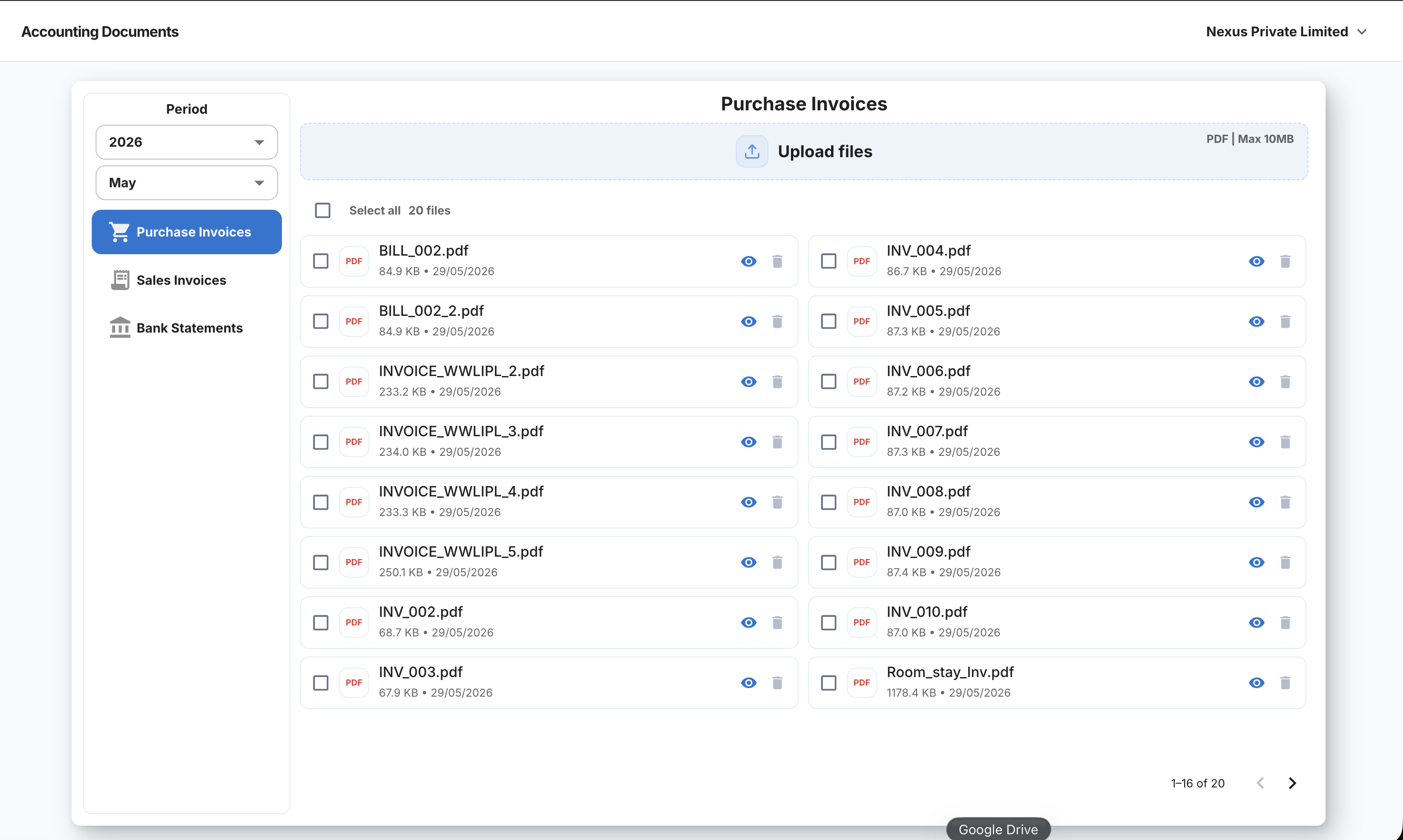
Step 1: Bring your fragmented startup finance data together
Early-stage startups often have financial data in at least five places: a bank account, a Razorpay dashboard, a GST portal, a shared folder of vendor invoices, and an accountant's Tally file. Flick AI imports from all of these into a single workflow, eliminating the manual data collection phase that currently delays month-end close by 5–7 days.
Step 2: Convert invoices into ITC-ready accounting records
Vendor invoices received by email or WhatsApp are processed automatically. Flick AI extracts GSTIN, invoice date, taxable amount, GST amount, and vendor details — creating complete accounting entries without manual data entry and flagging invoices with missing GST information before they create ITC issues.
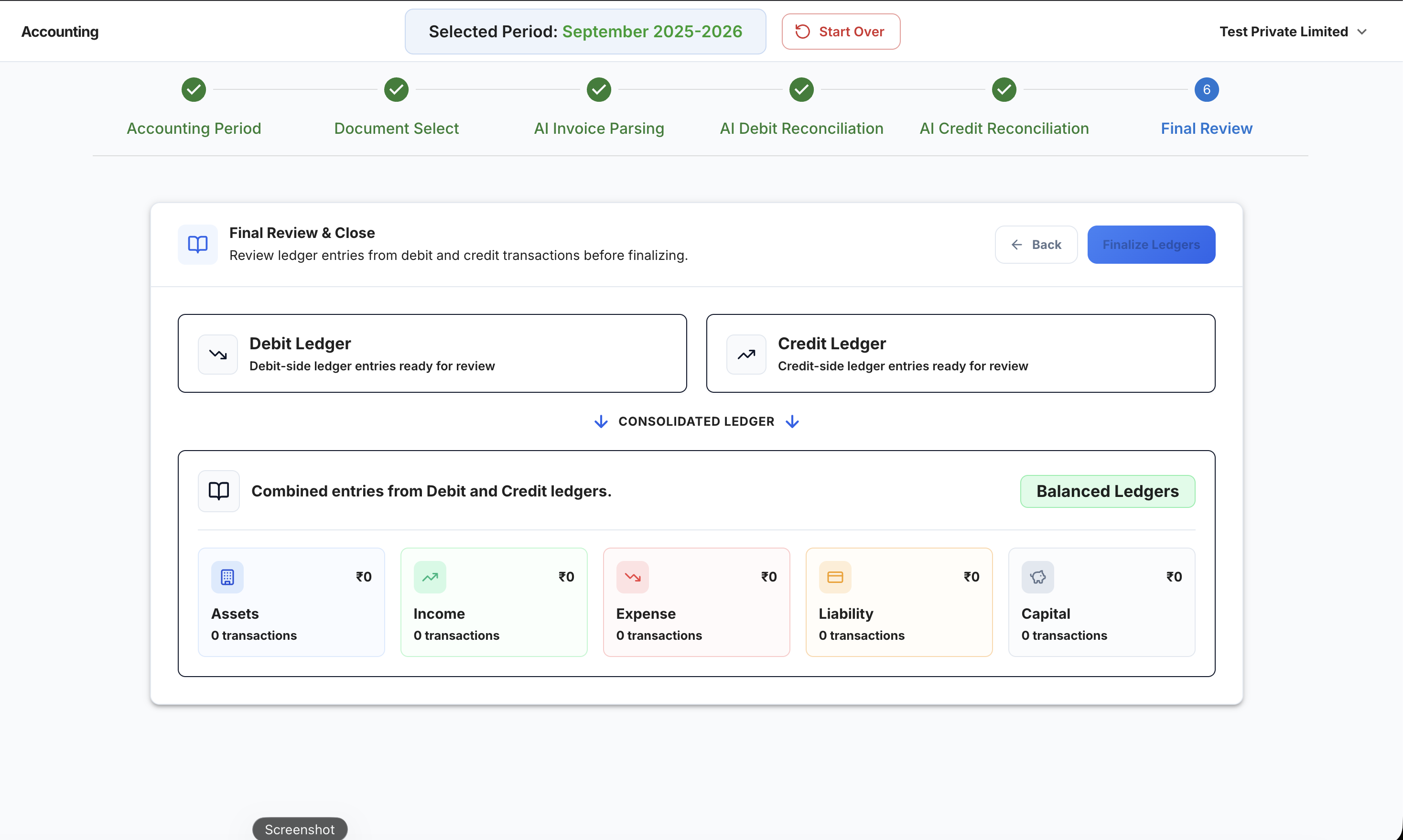
Step 3: Match bank transactions to invoices and payments
Bank credits from Razorpay settlements, UPI collections, and NEFT transfers are matched to outstanding customer invoices. Vendor payment debits are matched to approved bills. The result: a reconciled bank book updated daily rather than once at month-end. Startups looking to automate bookkeeping processes can also explore our AI Bookkeeping Software solutions.
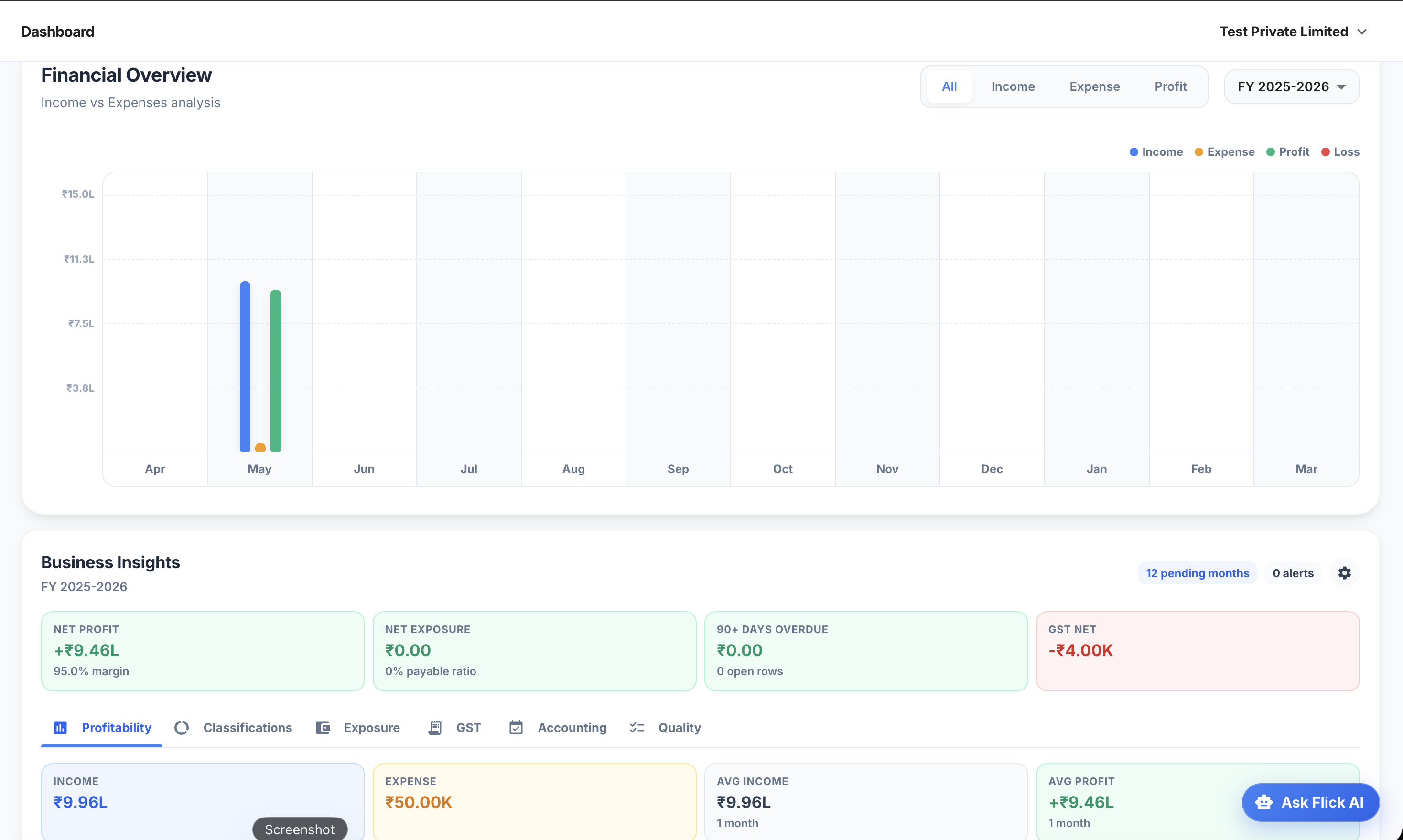
Step 4: Give founders a real-time financial position
Once transactions are matched and categorized, the key startup metrics , cash balance, burn rate, outstanding receivables, upcoming payables are available on demand. Founders get the visibility they need without waiting for the accountant to prepare a report. Businesses dealing with increasing reconciliation complexity can also explore our Bank Reconciliation Software capabilities.
Step 5: Prepare investor-ready financials anytime
P&L, balance sheet, cash flow statement, and receivables aging are available at any point during the month not just after month-end close. For due diligence or board reporting, 12-month financial histories are exportable in standard formats.
Step 6: Stay GST-compliant without the last-minute rush
Because invoices are processed as they arrive, GST data is maintained continuously. Monthly GSTR-1 data is ready before the filing deadline, ITC is tracked against GSTR-2B in real time, and there are no last-minute invoice hunts before filing day.
Product proof
Screens from the Flick AI workflow
.png)
.png)
.png)
Accounting Software for Different Startup Stages
The accounting requirements of a startup evolve significantly as the business grows. What works during the pre-revenue stage may no longer be sufficient once the company begins scaling operations, hiring employees, managing larger transaction volumes, or preparing for fundraising.
Startup stage progression
| Stage | Primary finance focus | What changes |
|---|---|---|
| Pre-Revenue | Expense Tracking | Organized records, subscriptions, professional fees, and compliance setup. |
| Seed | Cash Flow & GST | Customer payments, vendor expenses, employee reimbursements, and GST obligations increase. |
| Series A | Reporting & Controls | Investor reporting, financial controls, burn rate, runway, and month-end reporting expectations rise. |
| Growth | Scalability & Visibility | Higher transaction volumes require scalable workflows, faster reconciliation, and accurate reporting. |
Pre-Revenue
Primary finance focus
Expense Tracking
What changes
Organized records, subscriptions, professional fees, and compliance setup.
Seed
Primary finance focus
Cash Flow & GST
What changes
Customer payments, vendor expenses, employee reimbursements, and GST obligations increase.
Series A
Primary finance focus
Reporting & Controls
What changes
Investor reporting, financial controls, burn rate, runway, and month-end reporting expectations rise.
Growth
Primary finance focus
Scalability & Visibility
What changes
Higher transaction volumes require scalable workflows, faster reconciliation, and accurate reporting.
Pre-Revenue Startups
In the pre-revenue stage, startups are typically focused on product development, market validation, and building an initial team. Financial activity may be limited to founder contributions, software subscriptions, cloud infrastructure costs, professional fees, and operational expenses. At this stage, the primary objective is maintaining organized financial records, tracking expenses accurately, and ensuring compliance requirements are met from the beginning.
Seed-Stage Startups
As startups begin generating revenue and expanding operations, financial activity becomes more complex. Customer payments, vendor expenses, employee reimbursements, GST obligations, and recurring subscriptions create a growing volume of transactions that must be tracked accurately. Founders often need greater visibility into cash flow, expenses, and business performance to support growth decisions.
Series A Startups
By the time a startup reaches the Series A stage, financial reporting expectations typically increase significantly. Leadership teams often require timely visibility into revenue trends, burn rate, cash runway, receivables, payables, and operating expenses. Investor reporting, financial controls, and month-end reporting processes become increasingly important as businesses scale.
Growth-Stage Startups
Growth-stage startups often manage significantly higher transaction volumes across multiple customers, vendors, payment channels, and operational functions. At this stage, finance teams require scalable accounting workflows, faster reconciliation processes, accurate reporting, and greater financial visibility. The focus shifts from simply maintaining books to building finance operations that support sustainable growth and informed decision-making.
Startup Accounting Metrics Every Founder Should Track
As startups grow, financial visibility becomes increasingly important for decision-making. While maintaining accurate books is essential, founders often need a deeper understanding of the financial metrics that influence hiring plans, fundraising decisions, growth initiatives, and operational sustainability. The following metrics are among the most important indicators of startup financial health.
Monthly Burn
Monthly burn measures how much cash a startup spends each month after accounting for revenue and collections. It provides a clear view of the company's cash consumption and helps founders understand whether spending levels are aligned with growth objectives. Monitoring burn regularly can help prevent unexpected cash shortages and support better financial planning.
Cash Runway
Cash runway estimates how long a startup can continue operating before additional funding or increased revenue becomes necessary. This metric is particularly important for startups that are investing heavily in growth. Founders often use runway calculations when making hiring decisions, planning expansion initiatives, or preparing for fundraising discussions.
Accounts Receivable
Accounts receivable represent money owed to the business by customers. A startup may report strong revenue growth while simultaneously facing cash flow challenges if customer collections are delayed. Monitoring receivables helps founders understand collection cycles, outstanding invoices, and working capital requirements.
Accounts Payable
Accounts payable represent amounts owed to vendors, service providers, consultants, and other suppliers. Tracking payables helps founders manage cash flow more effectively, plan upcoming obligations, and maintain stronger financial control over business expenses.
Gross Margin
Gross margin measures how much revenue remains after accounting for direct costs associated with delivering products or services. Understanding gross margin helps founders evaluate business efficiency, pricing strategies, and long-term scalability. Strong revenue growth alone does not always indicate a healthy business if margins remain under pressure.
Monthly Revenue
Monthly revenue provides a direct view of business growth and performance. Tracking revenue trends over time helps founders identify growth patterns, evaluate business initiatives, and assess the effectiveness of sales and marketing efforts. Consistent revenue visibility also supports more informed planning and forecasting.
GST Liability
For Indian startups, GST liability is an important metric that should not be overlooked. Founders need visibility into GST obligations to avoid compliance issues, manage cash requirements, and prepare for filing deadlines. Maintaining accurate transaction records helps ensure GST-related reporting remains timely and accurate. Businesses seeking stronger GST management processes often implement GST Accounting Software to improve reporting readiness and compliance workflows.
Signs Your Startup Has Outgrown Spreadsheets
Spreadsheets often work well during the early stages of a startup. However, as transaction volumes increase and financial operations become more complex, manually maintaining financial records can become increasingly difficult. If several of the following situations sound familiar, it may be a sign that your startup requires more structured accounting processes and financial visibility.
Your business processes more than 200–300 financial transactions each month.
Multiple bank accounts, payment gateways, or UPI collection channels need to be tracked regularly.
GST reporting and compliance activities are becoming increasingly time-consuming.
Month-end bookkeeping and reconciliation take several days to complete.
Founders rely on multiple spreadsheets to understand business performance.
Investor updates require significant manual effort to prepare.
Different team members maintain separate versions of financial records.
Outstanding receivables and vendor payments are difficult to track accurately.
Financial reports are often available weeks after the end of the month.
Finance teams spend more time collecting data than analyzing business performance.